
Longitudinal Submerged Arc Welding (LSAW) is a complex, well-controlled metalworking method used to make API 5L X80 pipe. It is designed to provide high-quality mechanical stability for high-pressure transmission systems. The process starts with picking out high-quality steel plates that are then precisely formed. Next, automatic submerged arc welding is done along the longitudinal line. Post-weld heat treatment and thorough non-destructive testing make sure that the finished product meets the strict standards that oil and gas pipeline projects have to work in harsh circumstances.
|
|
|
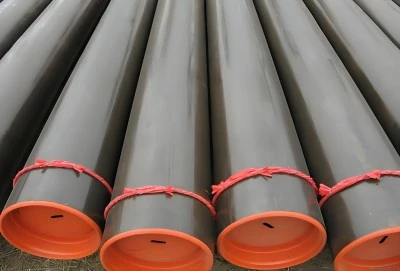
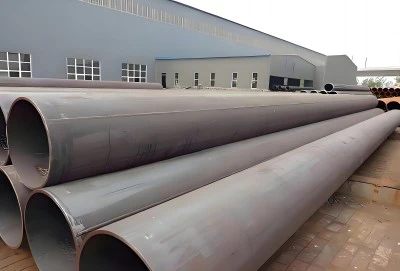
Step-by-Step API 5L X80 LSAW Pipe Manufacturing Process
Procurement workers can learn about quality control points and possible sources of variation that affect the consistency of the end product by understanding the API 5L X80 pipe production process.
Raw Material Selection and Quality Verification
Getting steel plates from approved mills is the first step in making api 5l X80 pipes that you can trust. Longma Group only buys raw materials from well-known Chinese companies like Shagang, Shangang, TISCO, BX Steel, Shougang, HBIS, and Bao Steel.
When the plates come in, they are inspected to make sure that they meet certain standards for mechanical traits and chemical makeup using optical emission spectrometry.
Mill certificates are compared to the specs for the buy, and an ultrasonic inspection of the parent plates finds any internal laminations or inclusions that might weaken the weld.
Plate Forming and Edge Preparation
Some steel plates are carefully cut to the right size, and then the edges are smoothed out by grinding or sanding to make sure they have clean, oxide-free surfaces that are necessary for good fusion. The flat plates are then put into forming tools, which bends them gradually to make the cylindrical pipe shape. Modern three- or four-roll bending machines use controlled compression and keep an eye on the springback properties to make sure that the diameter tolerances are exact. Automated tracking systems make sure that the edges are lined up correctly before welding, and the gap sizes are the same along the whole length of the pipe.
Longitudinal Submerged Arc Welding Execution
LSAW uses both internal and external welding heads that place and join metal along the length of the seam at the same time. The welding sparks stay clean from outside contaminants because they are covered in a blanket of granular flux. They also create the heat needed for full fusion.
Procedure qualification records (PQRs) specific to the chemistry of API 5L X80 materials are used to pre-qualify welding factors like current, voltage, travel speed, and flux makeup. Because the process is underwater, it makes deep penetration welds with little spatter and great mechanical qualities in the heat-affected zones and the metal that was welded.
Post-Weld Heat Treatment Operations
After the welding is done, the api 5l X80 pipes go through controlled heat treatment processes that smooth out the microstructure and remove any remaining strains. To normalize a heat treatment, the whole pipe is heated to temperatures above the upper critical transformation point and then cooled down slowly in room air. This heating cycle evens out the microstructure, gets rid of unwanted phases, and makes the toughness qualities best all over the pipe body and weld area. Stress relief processes at subcritical temperatures lower the locked-in pressures that come from welding and forming. This makes it less likely that the metal will crack from stress corrosion in service.
Comprehensive Non-Destructive Testing
Quality control depends a lot on strict checking rules that are followed for all production.
- Ultrasonic testing (UT) looks at both the weld seam and the pipe body to find internal flaws like holes, lack of fusion, or slag inclusions.
- Radiographic testing (RT) is another way to check, especially at the ends of api 5l X80 pipes where the stability of the link is very important.
- In hydrostatic testing, the inside pressures of each pipe length are raised well above the design conditions (95% of the minimum yield strength is usually used), and the lengths are watched for leaks or changes in shape.
Final Finishing and Protective Coating Application
Once the check is complete, the api 5l X80 pipes are ready for welding in the field by having their ends faced and beveled.
Verification of dimensions shows that the outside diameter, wall thickness, length, and ovality all meet the limits set by the standard. Then, protective protection systems are put on based on the needs of the project and the conditions of the area.
Our fabrication services offer a range of options, such as hot-dip galvanizing to protect against atmospheric corrosion, fusion-bonded epoxy (FBE) for general pipeline service, and multi-layer systems like 3-layer polyethylene (3LPE) or 3-layer polypropylene (3PP) for buried pipelines that need extra protection against corrosion on the soil side and damage during installation.
Procurement Considerations for API 5L X80 LSAW Pipes
To get a steady supply of API 5L X80 pipe material that meets specifications, you need to carefully evaluate suppliers and make sure they understand what the project needs.
Supplier Qualification and Certification Verification
Reliable makers keep their licenses up to date to show that they follow API 5L standards and quality management systems. When buying from possible sources, teams should check that the companies they're looking at have current API 5L monogram licenses from the American Petroleum Institute. This shows that the company is allowed to make api 5l X80 pipes with API markings on them. Getting ISO 9001 quality management certification is another way to make sure that factory processes are uniform and that quality controls are written down. Longma Group has many certifications, such as API 5L, ISO 9001, ISO 45001 for workplace health and safety management, and ISO 14001 for environmental management systems. These show that we are dedicated to producing excellence in every way.
Manufacturing Capacity and Delivery Capabilities
Large pipeline projects need suppliers who can keep up with tight building plans without lowering the quality of their work. When figuring out if a factory can meet your deadline, look at how much they produce each year, what tools they have, and how many orders they have in the queue. With special tools for making large-diameter, thick-walled api 5l X80 pipes, our plant produces more than 1,000,000 tons of steel every year. We can handle a wide range of project requirements because our diameters range from 1/2-inch to 72 inches and our wall thicknesses range from SCH10 to SCH160. When materials are available and production slots line up, flexible timing for production allows for faster delivery with wait times as short as seven days for urgent needs.
Applications and Future Outlook of API 5L X80 LSAW Pipes
High-strength API 5L X80 pipe materials are being used in more and more projects that want to be more efficient and leave less of an impact on the environment.
Critical Infrastructure Deployments
When it comes to applications, API 5L X80 standards are most useful for long-distance gas transportation systems. Transcontinental pipeline projects, like China's West-East Gas Pipeline lines, have successfully laid hundreds of kilometers of API 5L X80 pipe, reaching working pressures of more than 12 MPa while using the least amount of material possible. It is especially helpful in difficult areas where installation is hard to do because of remote access or rough terrain because of the high strength-to-weight ratio. For projects in Arctic and sub-zero environments, the material is used because it is very tough. The material can stay intact at temperatures as low as -45°C, even when the temperature drops and the ground moves because of permafrost.
Strain-Based Design Applications
Areas that are prone to ground instability and areas that are busy during earthquakes are using strain-based design methods that specifically allow pipelines to deform without breaking more and more. The API 5L X80 material has high regular elongation values and controlled yield-to-tensile ratios, which make these pipes ideal for uses where they need to be able to handle a lot of horizontal strain from ground movement. The material can bend easily while keeping the pressure inside, which is a key safety feature that sets it apart from lower-strength options. This is useful for pipelines that cross active fault lines or are built in areas that are prone to landslides.
Industry Evolution and Sustainability Trends
More automation, better process controls, and better quality tracking tools are all examples of how manufacturing technology keeps getting better. These changes lead to more uniform product traits and more efficient production. The business is under more and more pressure to lower its impact on the environment by using less energy in production and making materials easier to recycle. Steel pipes are naturally easier to recycle than non-metallic options, and makers are putting more emphasis on their eco-friendliness when talking to project owners who care about the environment. As the world's energy infrastructure grows, there will be a steady need for high-strength pipeline materials. This is especially true in developing markets that want to use natural gas as a transitional fuel to help with the integration of green energy.
Conclusion
By learning how to make API 5L X80 pipe correctly, procurement pros can make smart choices that balance performance needs, price limits, and project deadlines. Pipes that can handle the tough conditions found in modern energy systems are made using a complex process that starts with carefully choosing the raw materials and ends with strict testing. Understanding the differences in specifications, reviewing options, and carefully screening sources will help your company get reliable materials that will help the project run smoothly.
FAQs
What distinguishes API 5L X80 PSL1 from PSL2 specifications?
As part of PSL2, you have to do Charpy V-Notch impact tests and Drop-Weight Tear Tests at certain temperatures. You also have to follow stricter carbon equivalent limits to make sure the material can be welded in the field. A lot of API 5L X80 grade material is made to PSL2 standards because PSL1 doesn't check for toughness, which is needed for safe high-strength operation. PSL2 pipes are more expensive because they are made with stricter controls, but they are necessary for important uses where the chance of brittle fractures can't be allowed.
What are typical lead times for API 5L X80 pipe orders?
The normal time it takes to make something is between 30 and 60 days, but this depends on how many items are ordered, their sizes, and whether they need to be coated. When production capacity allows and raw materials are ready right away, faster delivery choices can cut lead times down to about seven days for an API 5L X80 pipe order. Orders with a lot of items or measurements that aren't standard may need longer wait times to allow for scheduling and quality checks during production.
Which quality certifications should buyers request from suppliers?
Active API 5L monogram licenses, ISO 9001 quality management certification, Material Test Certificates (MTC) with approved chemical and mechanical properties, and detailed Inspection and Test Plans (ITP) that list all quality checks are all important pieces of paperwork. Some projects in certain areas might need extra approvals, like a CE mark for European markets or an inspection report from a reputable agency.
Partner with Longma Group for Premium API 5L X80 Pipe Solutions
Choosing the right API 5L X80 pipe supplier has a direct effect on the success of the project, the ability to stay on schedule, and the long-term dependability of operations. We at Longma Group have been making LSAW pipes for more than twenty years and have a lot of certifications, such as API 5L, ISO 9001, and environmental management systems. Our 230,000-square-meter production plant makes sure that the quality is the same for diameters ranging from 1/2-inch to 72 inches. We also offer full manufacturing services, such as welding, coating application, and end treatments that are specifically designed to meet your connection needs. For detailed technical consultations, competitive quotes, and supplier partnerships that deliver specification-compliant materials on accelerated schedules to support your critical infrastructure goals, please contact our team at info@longma-group.com. We welcome project procurement managers and engineering contractors.








