
ASTM A53 ERW pipe is a Type E carbon steel pipe made by electric resistance welding. It suits industrial piping systems that carry water, compressed air, low-pressure steam, and fire protection supply. Grade B has a minimum yield strength of 35,000 psi and a minimum tensile strength of 60,000 psi, which covers most mechanical and low-to-moderate pressure service. Longma Group supplies Grade B from NPS 1/8 to NPS 26, in Schedule 10 to XXS, with lengths from 3 to 12.5 meters. I wrote this guide so US contractors and buyers can check specifications, testing, and sourcing details before they order.
|
|
|
What Is ASTM A53 ERW Pipe and What Must It Meet?
Type E Construction and Finishes
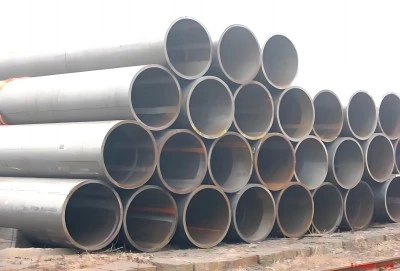
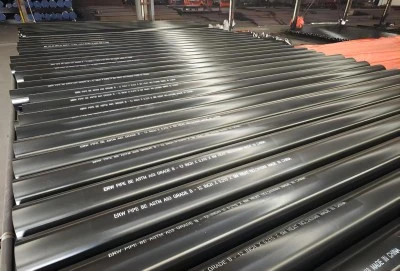
ASTM A53 has black and hot-dip galvanized steel pipe from NPS 1/8 to NPS 26. ERW stands for "electric resistance welded," and the standard name for this ASTM A53 ERW pipe is Type E. Steel coil is rolled into a circle at the mill. Electricity is then run along the edges to join the coils together without any filler metal. After the joint line is heated, it is measured and cut to the right length. The walls stay smooth and round because the width of the strip stays the same all the way across. That helps when you thread and groove. Black pipes have iron on the outside, which makes them shiny. Galvanized pipe doesn't get wet because it has a zinc layer covering it. If a pipe doesn't have a weld seam, it's called Type S. If it does, it's called Type F.
Grade B Chemistry and Mechanical Properties
That's the score we give out, so I'll start with B. Some of the things that can't be in Type E Grade B are carbon at 0.30%, manganese at 1.20%, phosphorus at 0.05%, and sulfur at 0.045%. Capped carbon and sulfur help the metal stick together, and the lack of phosphorus makes it hard to break. The strength in tension must be at least 60,000 psi (415 MPa), and the strength in yield must be at least 35,000 psi (240 MPa). In Grade B, we can pull 31,000 psi, but in Grade A, we can pull 48,000 psi. This means that Grade B is better for pressure and structural loads. The standard also says that the Grade B weld seam needs to be heated to at least 1000°F (540°C) or worked on until there is no more untempered martensite. In this step, the seam is kept close to the pipe body so that it can work.
Compliance Documents Buyers Should Request
People who are in charge of projects often want to know if a mill really follows ASTM A53, so don't just look at the signs. In a mill test certificate (MTC), the heat number, the size, and the tensile and yield results should all be written down. There should be the same heat number on both the pipe markings and the packing lists. This lets you keep track of materials as they go from the factory to the job site. Longma Group gives you an MTC, an Inspection and Test Plan, and a Specification for the Manufacturing Process. We keep track of everything, from empty boxes to finished goods. Things we use come from mills in China, such as TISCO, Baosteel, Shagang, and HBIS. You can also agree to have a third party check the work before it is made for foreign jobs.
Dimensions, Schedules, and Industrial Applications
Sizes, Schedules, and Wall Thickness
The pipe's name comes from its NPS number. As planned, the outside diameter of each NPS stays the same, but the wall thickness changes. There is less flow area and inside width when the wall is wider. The sizes come from ASME B36.10M. The NPS range from Schedule 10 to XXS, and the NPS range from 1/8 to 26. Here are three standard sizes and the plain-end sizes that go with them:
| NPS | OD (in) | Sch 40 wall (in) | Sch 40 (lb/ft) | Sch 80 wall (in) | Sch 80 (lb/ft) |
|---|---|---|---|---|---|
| 2 | 2.375 | 0.154 | 3.65 | 0.218 | 5.02 |
| 4 | 4.500 | 0.237 | 10.79 | 0.337 | 14.98 |
| 6 | 6.625 | 0.280 | 18.97 | 0.432 | 28.57 |
After getting the final numbers, you should always compare them to the current standard and the provider's data sheet.
Schedule 40 Versus Schedule 80
Schedule 40 is strong, light, and cheap, so it is mostly used for water, fire hoses, and compressed air. It weighs 38% to 51% more per foot than the other sizes. The price and freight go up because of the extra steel, and the pressure loss is higher at the same flow rate because the bore is narrower. Heavy walls can be helpful when rust, higher pressure, or threaded parts make a wall less useful. Pipe sizes should be determined by the flow rate, the amount of pressure drop that can happen, the temperature, the amount of rust that can happen, and how the pipes will be connected. They should check the wall thickness according to the rules in the code, such as ASME B31.3. It doesn't make sense to choose a schedule just because it's available.
Applications and Black Versus Galvanized Finish
Businesses use ASTM A53 ERW pipe to link utility lines, fire sprinkler mains, water lines, hot and cold water loops, and compressed air lines. Because it can hold weight, Grade B is also used for building things and making micropiles. There are sprinkler systems in NFPA 13 under ASTM A53; however, each project still needs to be cleared by the right people. For gas, steam, and pressure service, you need to check the local rules, which include how to connect and how much you can use. Black pipe works best and costs less for dry or painted lines inside. The zinc coating on hot-dip galvanized pipe is about 1.8 oz/ft², so it doesn't rust when it's wet or outside. It needs to have more airflow and the coating fixed before it can be joined together. Longma Group has coatings for metals that don't rust, like hot-dip galvanizing.
ASTM A53 ERW Pipe Comparison and Selection
Comparison with A106, A500, and API 5L
The pipe is made of carbon steel and doesn't have a weld gap. It is used in hot places. Pipes of this type are often used for power and industrial lines. There is no pressure pipe in ASTM A500; it only covers cold-formed structural tubing. In other words, it can only be used for frames and columns and not for fluid lines. API 5L is a standard for line pipe that moves oil and gas. It has its own way of checking and assigning grades. ASTM A53 ERW pipe is in the middle. It is less expensive than Type S pipe and can handle fluids with low to moderate pressure as well as mechanical work. It's not possible to pick one over the other. If you do, you might mess up the project design and local code. This company also makes ASTM A500 and API 5L goods, so I can give you choices if the plans need them.
Five Steps to Select the Right Pipe
I do five things. The first thing you need to do is name the fluid, its pressure, temperature, flow, and the code that controls it. Second, have an expert look over the grade, Type E building, finish, NPS, and wall thickness before you decide. Third, look at the licenses, tests, NDE, coating inspection, and make sure you can keep track of the product. Fourth, add up all the costs and wait times for mill-direct, distributor, stock, and made-to-order choices and find the best one. Fifth, make a list of all the requirements that have been accepted in the buy specification. You should get written permission before you change anything. Without this order, the steel would not be cut or shipped until mistakes are found. This keeps your schedule safe. This is about stock. Longma Group always has 200 to 300 tons on hand, and our quickest delivery time is 7 days.
Purchasing Mistakes to Avoid
Papers and quotes that don't match cause most of the problems I see. They believe the A53, A106, and A500 are all the same. Some people pick Schedule 40 or 80 because they are available, not because they look good. A lot of people compare quotes that use various grades, styles, test ranges, Incoterms, or price units, such as per ton vs. per meter. Some people don't check to see if the names on the pipes and the packing lists match the MTC heat numbers. Others don't think about things like end caps that protect during storage or ways to keep moisture out during shipping. Making mistakes can delay the approval of an inspection or require more work. Also, goods that are late can lead to fines for not following the plan. The RFQ has a short list of risks that takes care of most of them.
ASTM A53 ERW Pipe Inspection, Testing, and Certification
Hydrostatic Testing and NDE
ASTM A53 says that every length of pipe must pass a hydrostatic test. This means that it must stay under a certain amount of pressure for at least 5 seconds without leaking. A different nondestructive electric test is also allowed by the standard. This test uses ultrasonic or electromagnetic inspection to find flaws in the seams. The field pressure test checks the system that was put in place to make sure it meets the plumbing code and project requirements. This mill test is not the same as that test. If the order says so, a visual check, eddy-current testing, or X-rays can also be part of the weld-seam checking process. You need to write down the test that needs to be done on the order because the right way to do it depends on the standard, the order, and the pipe code.
Mechanical and Coating Checks
Tests with metal make sure the pipe can bend and hold weight. One way to test ASTM A53 ERW pipe NPS 2 and bigger is to squeeze a piece between two parallel plates. The weld won't open until there is less than two-thirds of an inch of space between the plates. Pipes less than NPS 2 are checked for bends. The minimum tensile strength of 60,000 psi and yield strength of 35,000 psi for Grade B are without a doubt correct. Mills check the outside diameter and wall thickness along with the tolerances. Metal pipe that has been coated with zinc has an average weight of 1.8 oz/ft². You can test for hardness or impact for an extra fee, so if the project needs it, add it to the order before it's made.
Reading an MTC and Planning Third-Party Inspection
One steel heat is linked to its test findings by an MTC. Find out about the chemistry, how long it stretches, the test results, its tensile and yield strengths, and its heat number. Then look at the pipe numbers and see how they match up with the heat number. Acceptance should stop if there is a match. Longma Group has MTCs, an ITP, and a standard for the production method. The building we're in is ISO 9001 certified. Before the project starts, make sure that everyone agrees on the third-party inspector, hold points, dimensional checks, and scope of the coating inspection. You can keep your landing date and avoid trouble at the port if you take care of these things early.
How to Buy ASTM A53 ERW Pipe from a Qualified Manufacturer
Writing a Complete RFQ
Sending a full request for quotation saves a week of emails. In the ASTM A53/A53M edition Grade B, you should list the NPS, schedule, length, finish, number, packing, Incoterms, target port, and certification needs. Change each quote to a single number before you compare them. Prices will be given by the ton, meter, piece, or group. Because of galvanizing, testing, freight, and taxes, the price of coils and the cost of landing change. This is a better way to compare prices than looking at the ex-works price. If you buy by the ton, check the weight against what it says it should be and get written proof of any changes. When you call the supplier for the first time, let them know about any possible extra orders. This way, they can plan their stock.
Evaluating a Manufacturer
Check the range of production, the thickness of the walls that can be handled, the project experience, and the ability to handle repeat orders. You should ask to see an example of the MTC, the heat tracing process, the weld-seam inspection method, the dimensional control records, the hydrostatic test records, and the coating inspection reports. It's also important to pack the pipes well because protecting the ends, keeping water out, bundling, and filling the containers can change how the pipes are when they get there. On a 230,000-square-meter site, Longma Group has been making ERW and LSAW steel pipe since 2003. We will have made more than 1,000,000 tons of steel every year by the end of 2023. We ship to over 90 countries and handle all the paperwork and rules in each one. With that much, we can plan delivery so that it doesn't come as a surprise.
Stock, Lead Time, and Services from Longma Group
We keep 200 to 300 tons of Grade B pipe on hand to keep project prices low. Seven days is the quickest time we can ship, but the exact time will depend on the size, finish, and number of items you order. We sell ASTM A53 ERW pipe in 8 sizes, from NPS 1/8 to NPS 26, in sizes 10 to XXS and 3 to 12.5 meters long. We also do hot-dip galvanizing and other finishes that prevent rust. For mating joints, we can weld, perforate, expand, and do other end treatments. Engineering companies, stockists, and exporters all use these services, so one order can cover pipes, finishes, and papers.
Conclusion
As long as the design conditions are kept simple, Type E ASTM A53 ERW pipe in Grade B can meet many industrial needs for water, air, fire protection, utilities, and general pressure. It is stable because it has a minimum tensile strength of 60,000 psi and a yield strength of 35,000 psi. The chemical and heat treatments at the weld seam are also controlled. The best way to use A106, A500, and API 5L depends on how well the schedule, finish, and standard fit the service. This is because they are used for different things. To make sure that every lot is of good quality, it is tested with water or electricity, shaped and flattened, welded, and an MTC with matched heat numbers. Buyers should also write a full RFQ, compare delivered costs in a standard unit, and not only judge a manufacturer by unit price, but also by how well they can track, inspect, pack, and deliver.
FAQ
1. What is the difference between Grade A and Grade B?
Grade B offers higher strength: 60,000 psi tensile and 35,000 psi yield, against 48,000 psi and 30,000 psi for Grade A. Grade B is common in pressure and structural use, and it is the grade we supply.
2. Can ASTM A53 ERW pipe carry gas or high-temperature fluids?
As long as the rules of the area, the way it is worked on, and the way it is joined allow it, it can handle low- to moderate-pressure gas, water, and air. This needs to be okay with a professional. For high temperatures, like power plant steam, ASTM A106 is the better choice.
3. Is Type E pipe the same as Type S pipe?
No, Type E has a seam that was welded together from a coil after it was heated, tested, and allowed to dry. There is no break in Type S. The walls of Type E are all the same width, and it costs less. Type S, on the other hand, can handle higher temperatures and pressures.
4. What does an MTC contain?
The heat number, chemistry, mechanical results, sizes, and test results are all shown. Compare the marks after putting it on the pipe.
Request an ASTM A53 ERW Pipe Quotation from Longma Group
These are the ASTM A53 ERW pipes that Longma Group sells. They keep 200 to 300 tons of Grade B stock in sizes NPS 1/8 to NPS 26 and Schedule 10 to XXS. It only takes seven days for them to send the pipes. Email us at info@longma-group.com with the grade, size, schedule, finish, quantity, destination, and certification information you need, and we'll send you a quote that fits your project. You may also pick MTC, ITP, or sparks.