
ISO 3183 L450 pipe is designed to withstand high pressure in onshore oil and gas pipelines. This grade provides the mechanical capability required for high-performance transmission applications, with a minimum yield of 450 MPa and a minimum tensile strength of 570 MPa. API 5L X65 is technically comparable and operates successfully in onshore gas trunk lines, oilfield gathering systems, and urban high-pressure distribution systems. L450 is an established and cost-effective alternative for EPC procurement teams sourcing pipe for projects in the Middle East, Southeast Asia, or South America.
|
|
|
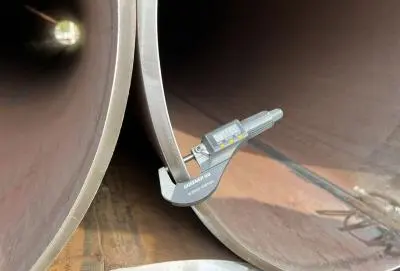
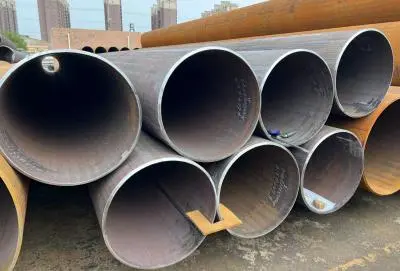
Understanding ISO 3183 L450 Pipe and Its Standards
What the ISO 3183 Standard Covers
ISO 3183 is the international standard for steel line pipe for the transportation of oil and gas. It ranks pipe classes based on minimum yield strength. The “L” in front of the number is for “Line Pipe,” and the number is the yield strength in MPa. Here, L450 is at the medium to upper level, above L415 and below L485. It is within the range of pressures of most importance for long-distance onshore pipelines.
Mechanical and Chemical Properties
The L450 grade is made from low carbon Nb/V/Ti micro-alloyed steel with very low and regulated levels of sulfur and phosphorus. The minimum yield strength is 450 MPa, the minimum tensile strength is 570 MPa, and the minimum elongation is 21%. The numbers are the same for PSL1 and PSL2 levels. PSL2 is essentially the same except for Charpy V-notch impact testing and tighter chemical controls.
Manufacturing Methods and Delivery Conditions
L450 pipe is supplied in a seamless form for the smaller sizes. It is available in large diameters in longitudinal submerged arc welded (LSAW) pipe. The steel may be supplied in two conditions, ME (thermomechanical as rolled) and QE (quenched and tempered). Both circumstances provide Charpy impact resistance as low as -40 °C, fulfilling the crack arrest requirement for most terrestrial permafrost regions from the Drop Weight Tear Test (DWTT).
Evaluating ISO 3183 L450 Pipe's Capability in High-Pressure Applications
Design Pressure and Mechanical Behavior
The pipes are hydrostatically tested to 90% of their minimum yield strength as per the hydrostatic test procedure of ISO 3183 L450 pipe. This indicates that L450 pipes can bear internal test pressures close to actual working loads plus a specified level of safety. Its high yield-to-tensile ratio allows engineers to optimize wall thickness, reducing pipe weight without sacrificing the capacity to bear pressure.
Corrosion Resistance in Harsh Environments
For sour service applications with low H2S concentration, the PSL2 variant of L450 may be selected to fulfill the requirements of NACE MR0175 for mild sour service. It is compatible with external corrosion protection FBE (fusion bonded epoxy) and 3PE coatings and with internal coatings that minimize drag. These covering technologies have been used in pipeline projects in the Middle East and Southeast Asia, which are dry, wet, and salty.
Field Performance Evidence
The L450 PSL2 pipe was selected for this major onshore gas transmission project in Central Asia since it offers the ideal balance of pressure capacity and weld economy, plus cold-weather robustness for the main trunk line. Field experience from comparable projects indicates that the L450 pipe, if properly coated and inspected, has a designed service life of more than 30 years under typical working circumstances, assuming welding methods and inspection protocols are followed precisely as prescribed.
Comparing ISO 3183 L450 Pipes with Alternative Pipe Grades for High-Pressure Use
Selecting the proper grade is a professional and economical decision. And here’s how L450 compares to alternatives procurement teams routinely consider:
- API 5L X60 / L415: L415 has lower yield strength (415 MPa) than API 5L X60, which means thicker walls will be required to reach the same pressure rating. L450 provides the same confinement with less steel, reducing overall material cost per kilometer on long-haul projects.
- L485 / API 5L X70: L485 has greater pressure capability but needs stricter heat treatment controls, more specialist welding consumables, and higher manufacturing cost. By selecting L450, projects whose operational pressure does not require X70-level strength save procurement complications.
- ASTM A106 Grade B: A106 Grade B is a seamless carbon steel pipe used in high-temperature duty but not designed for long-distance gas transport. Its minimum yield strength of 240 MPa and toughness qualities are far below L450, and it is not suited for trunk line applications.
Comparisons reveal that L450 offers a good balance between the ordinary carbon grades and the ultra-high-strength grades. It is more robust than normal carbon grades, cheaper than ultra-high-strength grades, and is completely supported by recognized welding and inspection techniques.
L450 is obviously limited. This material is not recommended for undersea pipelines operating under high pressure, in regions where the temperature is below -45 °C, or in conditions where there is a lot of hydrogen sulfide. Where these conditions are met, L555 or duplex stainless steel varieties are to be considered for the project.
Procurement Guide: Sourcing ISO 3183 L450 Pipes for High-Pressure Projects
Supplier Qualification Criteria
EPC procurement teams should make sure that any ISO 3183 L450 pipe provider has a valid API 5L license that covers the length of the project, provides EN 10204 3.1 or 3.2 material test certificates (MTC), and allows third-party inspection by SGS, Bureau Veritas, or a similar organization. It should be standard for weld seams to be tested with both ultrasonic (UT) and radiographic (RT) tests on the whole body.
Evaluating Manufacturing Capability
It's hard to work with large-diameter thick-wall L450 pipe. Check to see if the manufacturer can meet the needed OD and wall thickness, uses qualified welding methods for the microalloyed chemistry, and has a written production quality plan that includes an Inspection and Test Plan (ITP) and a Manufacturing Procedure Specification (MPS). Most owner audit standards need to be able to track the heat from the raw material to the finished pipe.
Lead Time and Logistics
When it comes to EPC jobs with tight deadlines, wait time is a real risk. Some manufacturers offer quick delivery on standard sizes that are in stock, which can be very helpful when a project's schedule changes at the last minute. Check the export packing standards, the loading port, and the supplier's ability to work with owner-designated inspection agencies before the product is released.
Best Practices for Using ISO 3183 L450 Pipe in High-Pressure Service
Welding and Inspection Procedures
One useful thing about the L450 is that matched welding supplies are easy to find, and the welding needs can be handled in the field. Before they are used, girth weld procedures should be checked to make sure they meet the needs of the project. For standard wall thicknesses, post-weld heat treatment is usually not needed. This cuts down on field cycle time.
Coating Application and Maintenance
Before lowering in, the FBE and 3PE coating systems that were put on L450 pipe must be checked for holiday flaws. When designing cathodic protection systems, they should work with the coating requirements. If you want to use internal coatings to reduce drag, you need to make sure that the application temperatures and curing times are right for the pipe's shipping state.
Documentation and Material Traceability
Each joint should have a heat number that can be linked to the MTC. ITP stop points for measurement inspection, hydrostatic testing, and NDE sign-off should be talked over and agreed upon with the inspection team of the owner before production begins. Any EPC project that is audited by a third party must have full documentation packages that include MTC, weld records, NDE reports, and hydrostatic test certificates.
Conclusion
It is technically sound to use ISO 3183 L450 pipe for high-pressure oil and gas pipeline service on land. It is the most commonly chosen grade for coastal trunk lines around the world because it has a yield strength of 450 MPa, can be tough down to -40 °C, works with normal anti-corrosion coatings, and has been used for a long time to support welding. It works well within a clear service area. If the grade is properly matched to the project's pressure, temperature, and fluid conditions, procurement teams will find that L450 gives consistent performance at a cost that is competitive with other projects.
FAQ
1. What is the maximum operating pressure for L450 pipe?
Maximum operating pressure depends on pipe OD, wall thickness, and applicable design code (e.g., ASME B31.8 or ISO 13623). With yield strength of 450 MPa, L450 supports high design pressures across typical trunk line diameters when wall thickness is selected accordingly.
2. Is ISO 3183 L450 the same as API 5L X65?
Yes. L450 under ISO 3183 is technically equivalent to X65 under API 5L. Both designate 450 MPa minimum yield strength. Many projects accept material certified to either standard, which gives procurement teams sourcing flexibility.
3. Can L450 PSL2 be used in sour service?
PSL2 L450 can be specified for mild sour environments with low H₂S content, in line with NACE MR0175 requirements. For severe sour service, a materials engineer should confirm suitability based on H₂S partial pressure and temperature.
4. What certifications should I require from an L450 pipe supplier?
At minimum: valid API 5L license, EN 10204 3.1 MTC (3.2 for owner witness inspection), 100% UT/RT test records, and hydrostatic test certificates. Third-party inspection reports from SGS or Bureau Veritas add another verification layer.
5. What are the lead times for large-diameter L450 pipe?
Lead times vary by OD, wall thickness, and order volume. Standard dimensions may be available from stock for fast delivery. Custom specifications typically require 4–10 weeks from order confirmation, depending on the mill's production schedule.
Request a Quote for ISO 3183 L450 Pipe — Longma Group
API 5L and ISO 3183 line pipe from Longma Group has been used in projects in over 90 countries since 2003. We are a qualified ISO 3183 L450 pipe manufacturer that issues EN 10204 3.1/3.2 MTCs, helps owners inspect, and sends full documentation packages with ITP and MPS. Get in touch with our technical team to talk about the details of your project, ask for samples, or get a competitive quote. You can email us at info@longma-group.com.








