
High-frequency welding technology in ERW pipes joins the edges of a formed steel strip with high-frequency electric current and pressure, without filler metal. The current heats the edges to forging temperature, and squeeze rolls fuse them into a continuous longitudinal seam. For ERW black pipe, this method delivers consistent wall thickness, stable dimensions, and efficient production. Seam quality depends on tight control of frequency, power, speed, and edge alignment, plus testing such as hydrostatic, ultrasonic, and flattening checks. Below, we explain how the process works, what to verify, and how to specify coated pipe for pipeline and municipal projects.
|
|
|
What Is ERW Black Pipe and How Does High-Frequency Welding Form the Seam?
What Is ERW Black Pipe?
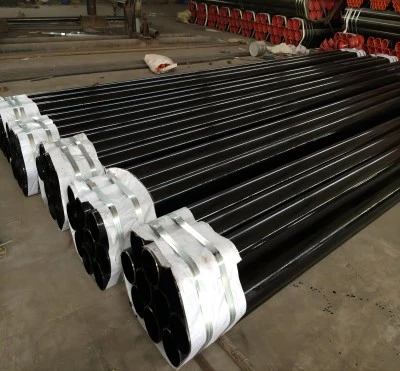
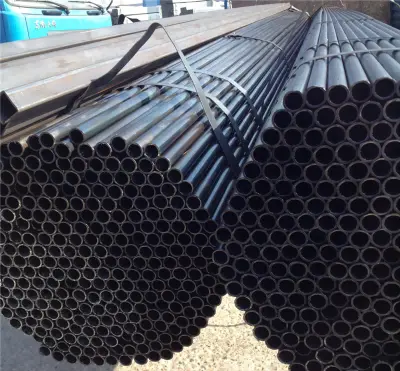
ERW black pipe is made of flat coils of hot-rolled carbon steel that have been joined together. ERW welding is used to join the long ends of the strip together after the mill cuts it into a round shape. The finish is dark and made of oxide or mill scale. There is a thin film of paint or oil on top to hide the rust for now. This surface is "black" because it is not treated or welded. Structures are built with it, and engineers use it as a base pipe for coats that are put on at the factory. It moves fluids with low to medium pressure. Longma Group sells ERW pipe that is black-coated and has a wall thickness of 6.02 to 50.8 mm and an outside diameter of 60.3 to 1422 mm. This means it can be used for lines of different sizes coming from the same source.
How Does the Welding Process Work Step by Step?
The first step in making something is picking out the right grade, standard, and size of hot-rolled coil. The line takes the strip apart, levels it, and cuts it. It is slowly shaped into a round tube by rolling it on rolls. An induction coil or sliding contacts send a high-frequency current to the two edges of the strip, which heats them up. To make the longitudinal weld, squeeze the rolls together and then press the hot edges together. While the pipe is still cool, the sizing rolls set the outside diameter and how round it is. The cuts then take off the flash of the weld. The pipe is cut to the right length with a saw, and then ends of different shapes and sizes are added. Depending on the plan, the next steps could be to check and clean the surface.
Why Does Seam Quality Matter for Coated Pipe?
The pipe wall is safe if you coat it, but that won't fix a weak weld. If a seam doesn't fuse properly or has a flaw that looks like a hook, it can leak before the sound coating breaks. If the surface is flat and smooth, like on a well-trimmed seam, coating applicators work best. This helps the film stay the same thickness all the way along the seam. Since inspectors usually look at the seam first, this is important for EPC teams that build things that will last for decades. We see welding control and being ready to finish as two links in the same quality chain. Learn how the seam is made, the pipe is heated, and the work is checked before it goes to the finish line if you want to buy a mill.
Process Controls, Testing, and Digital Monitoring in HFW Lines
Which Welding Parameters Matter Most?
To get a good weld, a few factors need to work together. The workers make sure that the frequency, power input, line speed, V-angle, edge alignment, and squeeze pressure are all equal. If the power is too low for the line speed, the edges never get hot enough to forge. The weld gets cold because of this. If the heat is too high or the pressure is wrong, the line might make too much flash, inclusions, or edge cracking. Local hardening can also happen when heat is added and then cooled down. When the form, size, alignment, and heat treatment are finished, they change how oval, straight, stressed, and hard the weld zone is. When all of these things are stable, not just one, a seam is made that works like the base metal.
Which Tests Confirm Weld Integrity?
There are several checks that must be done according to standards, and each one tells us something different. Putting water pressure on each length to see if it can hold pressure without leaking. Tests that use ultrasound or eddy current look for flaws below the weld line. In order to make sure the weld doesn't crack or open, a ring sample is pressed between two parallel plates. To find the sizes, the outside width, wall thickness, and straightness are all checked. An under-tolerance of 12.5% is allowed by ASTM A53 for walls. Chemical analysis has proven that the amounts of carbon, manganese, phosphorus, and sulfur that affect the ability to weld are real. Another name for seam heat treatment is normalizing. Normalizing gets rid of the hard, rigid structure in the area that was heated. This makes the seam as strong as the pipe itself. People who want to buy in the MTC should ask for these results.
How Do Monitoring and Traceability Reduce Risk?
The pipe is fed through a current HFW line, which records the welding power, line speed, squeeze pressure, and forming conditions. In this way, drift can be fixed before it affects a big batch. They use eddy current and ultrasonic waves to find flaws in seams and keep digital records of the coil and heat number of each pipe. To get coil, Longma Group buys it from mills such as TISCO, BX Steel, Shougang, HBIS, and Bao Steel. From the raw materials to the finished pipe, we keep track of the whole process. We also provide a Material Test Certificate (MTC), an Inspection and Test Plan (ITP), and a Manufacturing Procedure Specification (MPS) to QA/QC managers. These can be checked against the project requirements.
ERW Black Pipe Properties, Sizes, and Standards
What Are the Main Properties and Size Range?
Because the walls are all the same width and it is cheap, ERW black pipe is good for low- to medium-pressure fluid lines and building things. For ASTM A53 Grade B, the yield strength must be at least 35,000 psi (240 MPa), and the tensile strength must be at least 60,000 psi (415 MPa). When the wall thickness stays the same along the length, it's easier to cut, groove, and weld in the field. We have black ERW pipe that is 60.3 mm to 1422 mm in diameter and 6.02 to 50.8 mm thick on the inside. Performance is still based on the grade, the power of the welds, and the technology used to stop rust. The buyer should write down not only the stated size, but also the outside diameter, wall thickness, length, end finish, and any limits.
How Do You Calculate Pipe Weight?
Guessing the weight ahead of time helps with moving plans, freight, and money. If you know the diameter (t) and the length (D), you can figure out the weight in kilograms per meter. This is equal to 0.02466 times the wall thickness D. A pipe that is 219.1 mm wide and 6.35 mm thick, for example, weighs about 33.3 kg per meter. The weight of a box may be different depending on how it is packed, coated, and how the walls are made. Coatings and packaging materials add weight, so you should confirm the final weight with the supplier before booking freight.
Which Standards Fit Which Application?
The service will choose the best standard since it's not possible to switch between them. API 5L talks about line pipes and tells you how to test them and keep track of them. As long as the grade and tests are shown, ASTM A53 Type E says that ERW pipe can be used for both mechanical and pressure purposes. EN 10210 and AS/NZS 1163 are used for structural hollow parts, and ASTM A500 is often used for structural tubes. Lines are often used for gathering oil and gas, city water, district heating, fire protection, HVAC cold water and steam lines, and filling. For fire safety projects, it may be necessary to list or get permission. Send the mill the project facts, drawings, and rules before you give them a quote. This way, they can make sure they meet the right standards.
Comparing ERW Black Pipe and Choosing the Right Option for Coated Projects
How Does ERW Compare with SMLS Pipe?
They use SMLS pipe for services that need to survive high pressure, high temperatures, or are very important because it doesn't have a longitudinal joint. The seam on ERW black pipe is welded, but new HFW lines heat the seam and check it carefully to make pipe that can be used for many building and pipeline projects. ERW is easy to get and has walls that are all the same thickness. It costs less than SMLS for the same size most of the time. The choice is based on the needs of the project and the state of the business. Be sure to follow the limits set by the specification for ERW at a certain duty strain. If it lets you use ERW under API 5L, check the grade, PSL level, and test results.
How Does Black Pipe Compare with Galvanized Pipe and Coating Systems?
Most of the time, galvanized pipe won't rust outside, but black pipe needs to be painted, coated, or wrapped. The job of the coating system is to protect lines that are buried or underwater. We can coat things in FBE, 2PP, 3LPE, and 3PE, as well as hot-dip galvanizing. AWWA C210, AWWA C213, EN 10339, CSA Z245.20, and ISO 21809-1 are some important coating standards. Polyethylene has the number DIN 30670, and polypropylene has the number DIN 30678. Choose the best coating for the job. Some buried oil and gas lines work well with polyolefin systems, while steel water pipes work well with epoxy-based systems. Any black pipe that doesn't have a proper core shouldn't have potable water going through it.
How Should EPC Buyers Select Pipe and Coating Together?
Start with the details and work your way backward. Check to see what the coating standard is and how much of it needs to be used. Also look at the standard and grade of the pipe. Get information on adhesion, impact, and cathodic disbonding from a lab that has nothing to do with your project. Make sure that the temperature range that your plan needs is part of the test settings as well. Before the pipe ships, make sure that the factory coating and the field-joint coating work together. That's a different question that needs its own answer. For sea freight, get a written copy of the packing and security plan, because if the coating gets damaged during transport, the work has to be done at the port. Then look at what the mill makes, how it inspects, how it exports, and its paperwork.
Buying Guide: Quotes, Pricing, and Mistakes to Avoid
What Does an Accurate Quotation Need?
You need to give all the details for a quick and correct price. To get the pipe, we need to know its standard and grade, its outside diameter, its wall thickness or schedule, its length, its quantity, its end finish, its coating standard and thickness, where it's going, its Incoterm, and when it's due to arrive. A gathering line, a water main, and a scaffold all have different needs, so it's also important what it's used for. If you need an outside party to check things out, be clear about what they will be checking and who they are. Full specs cut down on going back and forth, so the mill could get work done faster. If you don't be specific, you'll probably get quotes that look cheap but don't include testing, sealing, or packing.
How Do Price, Stock, and Incoterms Affect Cost?
The price per ton depends on the coil's size, cost, order volume, certification, coating, packaging, shipping by land or sea, and cost. It takes longer to make things with custom sizes, ends, and finishing schedules, and you may need to buy a certain number of them. Stock sizes, on the other hand, can be sent out faster. What does the price you are given for EXW, FOB, CFR, or CIF cover? Does it cover checking, packing, marking, and export papers? Longma Group made more than 1,000,000 tons of goods every year by the end of 2023, and they were sold in more than 90 countries. A low price won't hide any problems if you look at the same specs line by line.
Which Mistakes Should You Avoid?
Things get wrong over and over in different projects. Some people buy ERW black pipes based only on their size, believe that all of them can handle pressure, or leave bare pipes outside in bad weather. Some don't check the seams' quality, whether they are round or straight, or whether they are uneven, which can affect how well they fit, join, and close. Another mistake that can cost you a lot of money is comparing quotes that differ in how they test, coat, or pack the goods. Costs can go up even if the unit price is the lowest if there is extra work, delays, or compliance gaps. Make sure that the standard, grade, wall thickness, end configuration, and inspection documents are all right for every order.
Conclusion
High-frequency current is used to heat the edges of a strip and forge them into a single seam without filler metal. This makes ERW black pipe. Controlling the frequency, power, speed, edge line, and squeeze pressure all at the same time is what makes the seam good. Hydrostatic, ultrasound, or eddy-current tests are used to check the seam's quality. The seam is also flattened and heated, and records are kept that can be tracked. Pipe sizes, forms, and weight depend on the standard (like API 5L or ASTM A53) and the way the rust is stopped. The walls of ERW pipe are more even and cost less than those of SMLS and galvanized pipe. Coatings that meet the norms of DIN, CSA, ISO, and AWWA stop rust. You can lower the risk of a project by being clear about what you want and by comparing quotes that are similar.
FAQ
1. Is the weld seam the weak point in ERW black pipe?
Not in making things right now. You can get a seam that fits the pipe body very well when you use HFW, heat treatment at the seam, ultrasound or eddy current testing, and flattening tests. Get the test records from the MTC.
2. Can ERW black pipe carry potable water?
Not until it's safe to do so. If you don't cover black steel, the inside will rust, so to be used for drinking, it needs to be lined or galvanized in a way that follows the rules in your area.
3. Which standard should I specify, API 5L or ASTM A53?
API 5L is best for pump projects that need to track PSL levels and do strict tests. Use ASTM A53 Type E for general mechanical and pressure duty. ASTM A500 or EN 10210 are often needed for building projects.
4. How do I verify coating quality?
Talk to someone outside of your company about the coating standard that is in your specification and how it measures up in terms of thickness, adhesion, impact, and cathodic disbonding.
Request an ERW Black Pipe Quote from Longma Group
Do you need coated pipe for a water project or a pipeline from a single source? Longma Group will make more than 1,000,000 tons of ERW black pipe every year starting in 2023. They have an API 5L certificate, ISO 9001 quality systems, and make more than 1,000,000 tons of goods every year. We have black-coated pipe with diameters ranging from 60.3 mm to 1422 mm, as well as FBE, 3LPE, and 3PE services and documents in ITP, MPS, and MTC. Your needs can be sent to info@longma-group.com by email.