
Choosing the right pipe for high-temperature service is not a decision you can afford to get wrong. When your project involves hydrocracking units, steam headers, or pressure vessels running at sustained elevated temperatures, material selection directly determines safety margins, inspection outcomes, and long-term asset integrity. ASTM A691 5Cr pipe — an electric-fusion-welded alloy pipe manufactured from 5% chromium, 0.5% molybdenum pressure-vessel-grade plate — gives procurement teams and piping engineers a technically sound, cost-effective answer for large-diameter applications where seamless pipe is either unavailable or prohibitively expensive. This guide walks through what you need to know before placing an order.
|
|
|
Understanding ASTM A691 5Cr Pipe for High-Temp Applications
What the Standard Actually Covers?
The ASTM A691 standard tells us how to make carbon and alloy steel pipes for high-pressure use at high temperatures using the electric-fusion-welding method and filling metal. The 5Cr grade number means that the base plate has between 4.00% and 6.00% chromium and between 0.45% and 0.65% molybdenum. Tensile strength must be at least 60 ksi (415 MPa), and yield strength must be at least 30 ksi (205 MPa). These numbers come straight from the ASTM A691 table requirements and are backed up by mill test certificates that can be linked to each plate heat number.
Heat Treatment Classes and Why They Matter
There are four classes in the standard: 12, 22, 42, and 42. These classes describe both the post-weld heat treatment (PWHT) regime and the radiographic testing (RT) requirement. PWHT is required for the 5Cr grade and can't be skipped. Without it, the martensitic grain that forms during welding stays very hard and not flexible, which is not allowed in any ASME B31.3 or B31.1 pressure pipe system. For Class 42, a full x-ray examination is needed, which is what most EPC project pipe material specifications (PMS) call for.
Corrosion Performance in Aggressive Environments
The 5% chromium presence makes it much more resistant to sulfidation at high temperatures than carbon steel or 1¿Cr grades. According to the Modified McConomy curves that are used a lot in API RP 939-C, alloy steels with 5% chromium have much lower corrosion rates than carbon steel at temperatures above 260°C in streams that contain sulfur. Because of this, the 5Cr grade is usually used for transfer lines between hydroprocessing units and overhead pipes for atmospheric distillation that work in places with a lot of H₂S.
Criteria for Selecting the Right Grade for Your Service Conditions
Operating Temperature and Pressure Rating
When used continuously at temperatures up to about 620°C (1150°F), the 5Cr-0.5Mo metal works well. When this level is crossed, 9Cr-1Mo or austenitic grades are needed. The 5Cr EFW pipe meets the ASME B31.3 allowable stress tables for projects that need to design at temperatures between 400°C and 600°C and high pressures. This is common for catalytic reforming or fired heater outlet piping. Before deciding on the wall thickness, you should always compare the design temperature and pressure class to the stress levels allowed in ASME B31.3 Appendix A.
Mechanical Properties and Impact Toughness
In addition to checking the tensile and yield strengths, procurement teams working on LNG-adjacent or cold-startup systems must also check the Charpy V-notch impact values. If you properly balance and temper the 5Cr grade (Class 22 or 42), it has the ductile-to-brittle transition properties that are needed for cold startup cycles. Ask for impact test results at the minimum design metal temperature (MDMT) that is listed on the project's progress management statement (PMS). If an ASTM A691 5Cr pipe passes 100% RT but fails Charpy testing at your MDMT, it is not a compliant pipe.
Weld Seam Quality and NDE Requirements
The weld seam is the most dangerous part of any EFW pipe. Your buy order should say that the longitudinal seam will be 100% radiographic tested (RT) and 100% ultrasonic tested (UT) for high-pressure work. These are not the same thing. RT finds flaws in the volume, like pores and inclusions, while UT finds flaws on the surface, like lack-of-fusion, that RT might miss. As part of the EN 10204 3.1 or 3.2 material test certificate package, each pipe length should also come with a report on a hydraulic pressure test at 1.5 times the minimum wall design pressure.
ASTM A691 5Cr Pipe vs. Alternative Materials
Comparison with ASTM A335 P5 Seamless Pipe
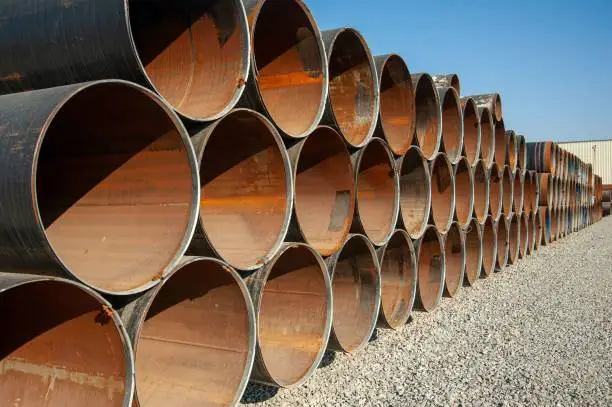
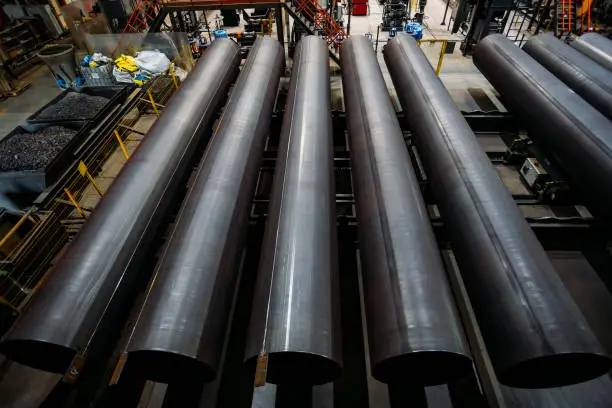
ASTM A335 P5 and ASTM A691 5Cr were made from almost the same chemicals. The change in purpose is in the way the product is made. The A335 P5 is smooth, and the A691 5Cr is EFW from plate. When the width goes above 24 inches (φ610 mm), it's technically impossible to make seamless pipes that are big enough to be used in business. The EFW method makes it possible to make pipes with sizes from φ457 mm to φ1422 mm and wall thicknesses that are the same as or greater than what seamless mills can make. This is why A691 is the standard for large-bore process piping.
Comparison with 9Cr and 12Cr Variants
For use above 600°C, the 9Cr-1Mo-V (Grade 91) and 12Cr grades have better creep strength and resistance to oxidation. But they need more precise welding methods, stricter PWHT windows, and more expensive filler metals. For uses between 400°C and 600°C where sulfidation protection is more important than high creep strength, 5Cr is still the better choice from a scientific and cost standpoint. It costs more and doesn't add value to specify 9Cr when 5Cr is enough.
Stainless Steel as an Alternative
Austenitic stainless steels (304, 316) are better at resisting oxidation, but they are more likely to crack due to chloride stress corrosion, have higher thermal expansion coefficients that make designing piping systems more difficult, and cost a lot more—often three to five times as much per ton as 5Cr alloy plate. The ASTM A691 5Cr pipe is a better choice for pipes in power plants and refineries where sulfur and hydrogen are present instead of chlorides. It has a better mix of performance and cost.
Procurement Considerations for EPC and Pressure Vessel Projects
Supplier Qualification and Documentation Requirements
For any EPC job that a third party checks, the documents are just as important as the pipe itself. Your supplier must give you EN 10204 3.1 or 3.2 material test certificates that show a full heat number trail from the pressure-vessel-grade plate mill to the final pipe. WPS/PQR records for the longitudinal seam weld, 100% RT and UT examination reports, hydrostatic test records, dimensional inspection reports, and PWHT time-temperature charts are some other documents that must be produced. Any hole in this package puts NCR at risk during inspection by a third party.
Lead Time, Diameter Range, and Third-Party Inspection
Large-diameter 5Cr EFW pipe is not usually kept in stock. Usually, it takes 8–14 weeks to make something, from getting the plates to the final review. Before sending out your RFQ, make sure the maker can press-form and weld sizes between φ457 mm and φ1422 mm. In the buy order, you should list third-party inspection companies like Bureau Veritas, SGS, or TÜV, along with specific witness and hold places that are in line with your project's integrated test plan (ITP). Vendors who have worked with resident inspectors before and keep their quality control records open greatly lower the risk to the project schedule.
Real-World Applications: Where 5Cr EFW Pipe Performs
The 5Cr grade has been used for a long time in three main industry settings. In oil plants, it works with streams of hydrocarbons in hydrocracking and catalytic reforming units, which are places where the amount of hydrogen sulfide and the temperature are higher than what carbon steel can handle. It is used as high-temperature steam headers and reheat system pipes in thermal power plants. The metal choice and weld quality have a direct effect on the creep-rupture life over a 20–30 year plant run. In petrochemical plants, this grade is usually required for large-diameter reactor nozzle connections and heat exchanger inlet/outlet piping that is used with hydrogen. This is because lower-alloy materials fail when hydrogen partial pressure and high temperature come together, causing cracking or rapid sulfidation.
Conclusion
It takes more than picking a grade from a standard sheet to choose the right pipe for high-temperature use. The ASTM A691 5Cr pipe is the best choice for a certain range of working conditions, from 400°C to 620°C, in settings that are sulfidizing or hydrogen-rich, and for diameters that make seamless pipe impractical. To be successful, you need to choose the right Class, expect full NDE coverage, check for PWHT compliance, and work with a supplier who can give your project QA system the full documentation path it needs. If you get those things right, the material will last as long as your plant does.
FAQ
How does ASTM A691 5Cr pipe differ from ASTM A335 P5?
Both share similar 5Cr-0.5Mo chemistry. The key difference is manufacturing method: A335 P5 is seamless, while A691 uses the EFW process from pressure-vessel-grade plate. For pipe diameters above 24 inches, A691 is typically the only practical option.
Is PWHT mandatory for the 5Cr grade?
Yes. PWHT is required for all 5Cr EFW pipe. It tempers the hard martensitic structure formed during welding and restores the ductility and toughness required for pressure service under ASME B31.3 and B31.1.
What NDE is required?
Class 42 requires 100% radiographic examination of the longitudinal seam. Most EPC project PMS documents also require 100% UT. Both tests are needed — they detect different flaw types.
Can 5Cr pipe be used in sour service?
Yes, with proper hardness controls. The finished pipe must meet NACE MR0175/ISO 15156 hardness limits. Hardness testing results should be included in the MTC package.
What filler metal is used for the seam weld?
The filler metal must match the 5Cr-0.5Mo base chemistry. E8018-B6 electrodes or equivalent GTAW/SAW filler wire are standard. Weld metal composition must be verified in the WPS/PQR documentation.
Get a Competitive Quote on ASTM A691 5Cr Pipe from Longma Group
Since 2003, Longma Group has been making large-diameter EFW alloy steel pipe for projects in more than 90 countries. We work directly with EPC procurement teams as a qualified ASTM A691 5Cr pipe supplier to provide full documentation packages that include EN 10204 3.1/3.2 MTCs, 100% RT/UT reports, PWHT records, and third-party inspection support. We can make things from φ457 mm to φ1422 mm. Send your RFQ to our expert team today by emailing info@longma-group.com or going to longma-group.com.