
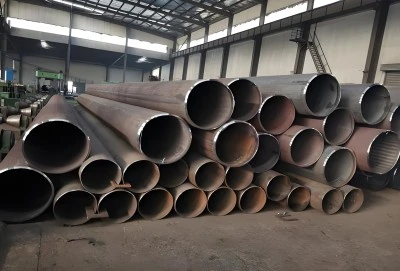
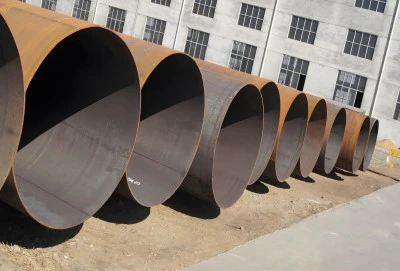
API 2B is a fabrication specification, not a material grade. Published by the American Petroleum Institute, it governs how structural steel pipe is manufactured from plate — covering dimensional tolerances, weld quality, and inspection requirements. The steel plate itself draws from separate material standards such as API 2H, API 2W, or ASTM A572. When engineers specify an API 2B pipe for offshore jacket legs or foundation piles, they are defining how the pipe must be built, not what alloy it contains. Understanding this distinction is the first step toward accurate procurement.
|
|
|
Understanding API 2B in the Context of Pipe Materials and Fabrication
What API Standards Actually Cover
The American Petroleum Institute puts out two main types of pipe standards. The first group, "material grades," describes the chemical make-up and mechanical features of the material. For example, API 5L tells us about the chemistry, yield strength, and tensile strength for line pipes that move fluids under pressure. The second group, fabrication specs, describes how the product is made, any necessary geometrical limits, and quality controls. This is where API 2B definitely fits in.
The Role API 2B Plays in Structural Pipe Manufacturing
Longitudinal Submerged Arc Welding (LSAW) is the main method used to make structural steel pipes from rolled plate according to API 2B. It says what kind of weld joint is needed, how out of round the part can be (usually within 1% of OD or 0.25 inches), how thick the wall has to be, and that a nondestructive examination has to be done. While the standard doesn't say anything about chemistry or yield strength, those things are determined by the plate material that is chosen, like API 2H Grade 42 or ASTM A633.
Why the Distinction Matters for Procurement
Not what kind of steel to use, but "API 2B pipe" is what the structural engineer writes on a project specification sheet. This tells the fabricator HOW to make the pipe. If the procurement head mixes this up with a material grade, they might end up getting the wrong thing. Along with the API 2B fabrication standard, the plate grade, impact toughness class, and other requirements must be listed in order to make a pipe that fully meets the technical goals of the project.
API 2B Pipes Features for Industrial Use
Dimensional Range and Wall Thickness Capabilities
Since API 2B pipe is plate-formed instead of extruded, it has almost no higher diameter limit that goes beyond what a mill can roll. Longma Group makes API 2B pipe with outside diameters ranging from 16" to 56" and wall thicknesses from SCH10 to SCH160. This range includes conductor caissons that aren't loaded very heavily and jacket legs that are loaded very heavily and must be able to handle pile-driving impact forces of over a thousand foot-pounds.
Weld Quality and Nondestructive Examination
For longitudinal seams, API 2B requires Double Submerged Arc Welding (DSAW), which makes full-penetration joints with mechanical properties that are the same as or better than the base plate. As required, 100% Ultrasonic Testing (UT) and Radiographic Testing (RT) are done on every weld seam. It is necessary to follow these rules because a single weld break in a jacket leg can cause a catastrophic brittle fracture, especially in the cold North Sea or deep Gulf of Mexico water.
Comparison With API 5L and ASTM Standards
API 5L is all about keeping the internal pressure inside to move fluids, and its wall thickness estimates are based on hoop stress. API 2B is all about external loads on structures, like axial compression, bending moments, and dynamic wave forces. ASTM A500 and A252 cover structural and pile pipe, but they don't go as far as the large-diameter, heavy-wall systems that offshore platforms need. An API 2B fabrication reference should be used whenever the pipe itself is the structure and not just a conduit.
Procurement Insights: How to Evaluate API 2B Pipes for Your Business Needs
Aligning Specifications With Project Design Documents
Before issuing a request for quotation, a procurement team should confirm three items: the required plate material grade and supplemental requirements (e.g., Charpy V-Notch testing at -40°F), the OD and wall thickness schedule called out in the structural design package, and any third-party inspection or certification requirements written into the contract. Misalignment on any of these three points commonly causes costly rework or delivery delays after fabrication has started.
Here are the core documentation items a supplier must provide for API 2B pipe procurement:
- EN 10204 3.1 Mill Test Certificate (MTC): Traces the pipe back to its source plate heat, confirming chemistry, tensile results, and impact test data. This document is non-negotiable for offshore structural applications where traceability prevents lamellar tearing failures.
- Weld Procedure Qualification Records (WPQR) and NDT Reports: Confirm that weld parameters are qualified and that each production seam passed 100% UT/RT. Buyers should request these as part of the Inspection and Test Plan (ITP) package, not as an afterthought.
- Dimensional Inspection Reports: Cover OD, wall thickness, straightness, and out-of-roundness measurements against API 2B tolerance tables. These affect fit-up precision during platform assembly and directly influence field welding costs.
These documents collectively protect the buyer from specification non-conformance claims and provide the evidentiary trail required by class societies and project owners.
Evaluating Delivery Capacity for Large-Diameter Heavy-Wall Pipe
Large-diameter thick-wall pipe is not a catalog item stocked by most distributors. Fabrication lead times at many mills run 8–16 weeks. Longma Group maintains a stock of 100–200 tons of API 2B pipe with a fastest delivery time starting at 7 days, which provides measurable schedule protection when a project's critical path is tight. Confirming actual rolling and delivery capacity — not just quoted lead time — is a key step in supplier qualification.
API 2B Pipe Solutions: Choosing the Right Supplier and Ensuring Quality
Certifications That Signal Genuine Competence
The portfolio of certifications a supplier has shows buying teams whether quality is systemic or situational. Along with an API 5L logo license, Longma Group also has an ISO 9001 Quality Management System certificate and an ISO 14001 Environmental Management System certificate. These licenses show that the quality system has been checked, not just said to be good.
Custom Length Fabrication and Anti-Corrosion Services
To keep field girth welds at nodal joints to a minimum, offshore structural pipe is often cut to lengths that aren't standard. Cutting down on the number of field welds directly lowers the number of places where fatigue can start in the splash zone. Longma Group offers cut-to-length manufacturing and anti-corrosion coating services such as FBE, 3LPE, and hot-dip galvanizing. These services cut down on the number of providers that a project team has to handle.
Raw Material Traceability From Mill to Delivery
The steel that we use for our plates comes from well-known Chinese companies like Baosteel, HBIS, and Shougang. The plate mill certificate all the way through to the finished pipe MTC is used to track heat and lots. For projects that need third-party inspection, we work directly with companies like Bureau Veritas, SGS, or TÜV Rheinland to set up witness inspections at our facility in Hebei, China.
Conclusion
API 2B pipe is a manufacturing standard that tells manufacturers how to make structural steel pipe. It does not describe the chemical or mechanical grade of the steel itself. Understanding this difference is important for procurement workers who are looking for large-diameter structural pipe for offshore platforms, wind foundation monopiles, or marine piling. It keeps them from making specification mistakes. Along with the API 2B reference, the steel grade, impact class, and other requirements must be included to make a full procurement specification. From the first question to the final delivery, project risk is greatly reduced when a provider has documented fabrication capabilities, traceable raw materials, full NDT compliance, and quick expert support.
FAQs
What is the difference between API 2B and API 5L?
API 5L is a standard for line pipes that move fluids under pressure inside the pipe. API 2B is a specification for making structural pipes for load-bearing parts like foundation piles and jacket legs. They are used for completely different engineering situations and shouldn't be switched around when applying to structures.
What steel grades are used to fabricate API 2B pipe?
API 2H (carbon-manganese), API 2W (thermo-mechanically controlled), API 2Y (quenched and tempered), and ASTM A572 are all common plate grades. The plate grade is chosen based on the yield strength needed, which is usually between 36 and 60 ksi, and how well it handles Charpy impacts at low temperatures.
Does API 2B cover spiral-welded pipe?
No. API 2B specifies longitudinal seam fabrication. Different rules cover spiral-welded pipe, and it is usually not recommended for main offshore structural members because the shape of the weld seam is not parallel to the main stress directions.
What documentation should I request from an API 2B pipe supplier?
Ask for an EN 10204 3.1 MTC, 100% UT/RT reports, weld process qualification records, dimensional inspection reports, and an ISO 9001 certificate from the seller. It is standard for offshore projects to have an Inspection and Test Plan that meets the quality standards of the project.
Can API 2B pipe be produced in custom lengths?
Answer: Yes. Because the pipe is made from plates, it can be cut to any length that is needed. By choosing longer lengths that are matched to the project, fewer field girth welds are needed on finished structures. This lowers the risk of fatigue and the cost of field welding labor.
Request an API 2B Pipe Quote From Longma Group Today
Since 2003, Longma Group has been making LSAW structural pipe for customers in more than 90 countries. We have API 2B pipe in sizes ranging from 16" to 56" OD and from SCH10 to SCH160 in stock. Delivery times start at 7 days. As a verified API 2B pipe manufacturer, we offer full MTC documentation, coordination of third-party inspections, and anti-corrosion coating all in one place. To get a detailed price right away, email your project details to info@longma-group.com or go to longma-group.com.