
When specifying pipeline materials for critical infrastructure projects, procurement managers and pipeline engineers frequently encounter this question: Are API 5L X46 PSL1 and L320 PSL1 pipes identical? The straightforward answer is no—while these grades share remarkably similar mechanical properties and can often serve interchangeable roles in many applications, they originate from distinct standard systems. API 5L X46 PSL1 pipe falls under the American Petroleum Institute specification, whereas L320 PSL1 aligns with ISO 3183 standards. Both deliver minimum yield strengths of 320 MPa, yet their certification pathways, testing protocols, and regional acceptance vary, making proper specification critical for compliance and project success.
|
|
|
Introduction
Engineers and procurement experts working on pipeline construction, oil and gas transportation, water supply systems, and offshore platforms must understand API 5L X46 PSL1 and L320 PSL1 pipe grades. Different criteria control pipe grades. In North America, API 5L governs them, but in Europe and elsewhere, ISO 3183/EN 10208-2 does. Each standard has unique criteria, performance characteristics, and legal acceptance profiles.
This guide explains their technical distinctions, emphasises chemistry and mechanics, and offers purchase suggestions. We discuss real-world examples where specification decisions affect project timeframes, costs, and operational reliability. Knowing these details will help you buy pipes for a large pipeline expansion in the Middle East or an offshore construction project in Australia that meet global engineering, quality, and regional compliance standards.
Understanding API 5L X46 PSL1 and L320 PSL1 Pipe Grades
API 5L X46 PSL1 pipe and L320 PSL1 represent line pipe types that are known all over the world and are mostly used for moving oil, natural gas, and water. In API terminology, "X46" means a minimum yield strength of 46,000 psi, which is about 317 MPa. In ISO 3183 terminology, "L320" means a minimum yield strength of 320 MPa. Because they have almost the same strength numbers, engineers often think of them as having similar functions, even though they came from different ideas about how to standardize things.
Defining API 5L X46 PSL1 Standards
API 5L was made by the American Petroleum Institute to set rules for line pipe used in pipeline systems for the natural gas and oil businesses. Product Specification Level 1 (PSL1) is the basic quality level in this system. It strikes a balance between low cost and solid performance for common service settings. PSL1 pipes are tested for hydraulic pressure and their dimensions. However, they don't have to go through stricter chemical makeup limits or Charpy V-notch impact tests unless specifically asked to.
Understanding ISO 3183 L320 Designation
Using metric notation, ISO 3183 gives similar standards that are accepted in many Asian and European countries. In terms of mechanical performance, the L320 grade and API X46 are exactly the same; they both aim for the same strength class. On the other hand, ISO 3183 often includes EN 10208-2 standards, which may require extra testing methods based on what the buyer wants. This measure is widely used in building projects in Southeast Asia, the Middle East, and Australia. In these places, metric specs are most common in procurement documents.
Chemical Composition and Mechanical Properties
Both grades have similar chemical limits that are meant to make sure they can be welded and keep their structure. Carbon content stays below 0.26% most of the time, manganese levels range from 0.90% to 1.40%, and phosphorus and sulfur levels can't be higher than 0.030% each. For both specifications, the tensile strength needs to be between 415 and 565 MPa. The best thing about the PSL1 designation is that it is flexible. This means that manufacturing processes can be made as cost-effective as possible while still meeting performance standards for standard pressure applications in water distribution networks, oil and gas transmission networks, and structural piling systems.
Technical Differences Between API 5L X46 PSL1 and L320 PSL1 Pipes
These grades are mechanically the same, but they are not the same when it comes to certification paths, regional acceptance, and how the testing protocol is interpreted. When procurement teams understand these technical details, they can avoid specification conflicts that could slow down customs clearance, make mill certification harder, or cause compliance issues during project handover.
Manufacturing and Welding Methods
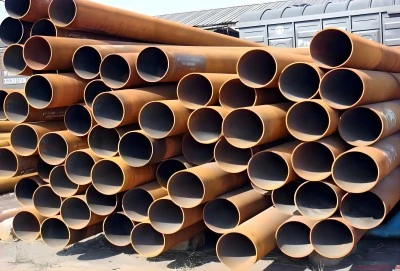
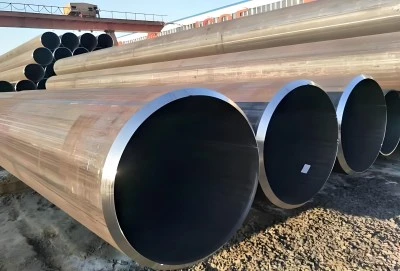
Multiple welding procedures can create API 5L X46 PSL1 pipes, giving you shopping alternatives and cost savings. Longma Group makes X46 PSL1 pipes using ERW, HFW, LSAW, DSAW, and SSAW. Each manufacturing method has advantages. ERW is suitable for lower diameters and fast production, whereas LSAW is best for thick-wall, large-diameter applications that require structural integrity.
The ISO 3183 manufacturing procedure for L320 PSL1 pipes is identical; however, weld seam quality documentation may be examined. Pipes for EU projects must be CE marked and Factory Production Control certified. Both requirements need heat treatment after welding to normalise weld seams to match base metal microstructure. This prevents brittleness and maintains mechanical qualities of the pipe body.
Quality Control Standards and Testing Protocols
API 5L PSL1 needs hydrostatic testing to control pressure, dimensional inspection to ensure wall thickness and diameter, and chemical analysis of ladle and product samples. Laminations, cracks, and deep surface anomalies are checked visually. Flattening and bending tests solely check welded pipes to ensure the weld seam remains intact when distorted. These fundamental standards provide dependable quality assurance for regular service situations without testing costs.
These requirements are identical to ISO 3183 L320; however, European buyers frequently include ultrasonic weld seam testing, X-ray inspection, and third-party inspection witnessing. Improved methods simplify tracking and document accuracy. Projects with extended audit trails or strong liability regulations benefit from this. Procurement managers should clarify the testing scope during RFQ to minimise unexpected expenses or delivery delays.
Certification and Regulatory Acceptance
API 5L accreditation is recognised on all North American projects and is growing in popularity, notably in the Middle East and Southeast Asia, where American technical standards are employed for most large-scale infrastructure projects. Certified API mills may provide validated Mill Test Reports (MTRs) with API branding. Engineering firms and government organisations find clearance simpler.
While ISO 3183 approval is demanding, it requires knowledge of regional conformity assessment methods. Products in European markets are supplied with EN 10204 3.1 or 3.2 inspection certifications, which require third-party testing. Australian projects may employ AS/NZS and ISO standards, requiring different compliance levels. Longma Group and other experienced suppliers maintain API 5L, ISO 9001, ISO 14001, and OHSAS 18001 certifications to ensure our pipes fit a variety of regulatory frameworks without requiring customers to scrimp on paperwork.
Comparison with Other Related Pipe Grades
Putting API 5L X46 PSL1 pipe in a wider range of line pipe grades helps procurement teams understand the trade-offs between cost and performance and find the best materials for each project.
X46 in the API 5L Grade Family
The API 5L standard provides grades from B (241 MPa yield) to X80 (552 MPa yield) based on minimum yield strength. X46 is average. Although it can bear greater pressure than Grade B or X42, it's cheaper than X52 or higher grades. This positioning makes X46 ideal for medium-pressure gearbox lines, 10–20 bar water mains, and structural usage that need medium strength without paying extra for high-quality materials.
Compared to X42 (289 MPa yield), X46's strength allows narrower walls while maintaining pressure. This might lighten the material and save transportation costs. In certain markets, X46 is 8–12% cheaper than X52 (358 MPa yield). This is the greatest option for design demands that don't need the higher grade. To maximise value without compromising safety, projects with limited finances generally pick X46 for walls with suitable thickness.
PSL1 versus PSL2 Specification Levels
PSL1 and PSL2 vary greatly in price and technical fit. PSL2 restricts chemical composition, notably phosphorus and sulphur. Low-temperature toughness and maximum yield-to-tensile ratios must be tested using Charpy V-notch impact. Full traceability requires marking and documenting everything. These standards are suitable for tough environments, below-freezing temperatures, or break-resistant applications.
PSL1 performs effectively in regular conditions without excessive toughness or hydrogen sulphide protection. The price difference is generally 15%–25%. PSL2 must be tested extensively and has narrower chemical windows. Procurement professionals should examine service circumstances. Over-specifying PSL2 when PSL1 will do may increase project expenses without justification, while under-specifying PSL1 for demanding settings might cause it to fail early. Longma Group's technical staff helps customers match precise standard levels to operational demands, improving safety and budget.
Welded versus Seamless Pipe Considerations
For X46, procurement teams may select welded or seamless production. Solid billets perforated to form seamless pipes have no longitudinal weld seams. These pipes are isotropic and have greater pressure ratings. Seamless manufacture costs 20–35% more than welded specifications and restricts diameters and wall thicknesses.
For most applications, LSAW or ERW welded pipes are strong. Modern welding, heat treatment, and ultrasonic testing ensure that connection gaps meet or surpass base metal characteristics. Well-made welded API 5L X46 PSL1 pipe provides the same service life as seamless alternatives at lower cost. Welded requirements are most frequent for large-scale water infrastructure and oil and gas transmission network procurement.
Practical Application and Procurement Considerations
To turn technical specs into good project results, you need to know where these pipe grades do their best work and how to set up buying plans that balance quality, cost, and delivery reliability.
Industry Applications and Project Suitability
Industries use API 5L X46 PSL1 pipe for many activities. X46 is used in medium-pressure crude oil pipelines, natural gas collection systems, and refined product distribution below 100 bar. City gearbox mains, industrial water distribution, and irrigation trunk lines use X46. Steel with corrosion-resistant coatings lasts decades.
In industrial production, X46 handles frame, compressed air, and process water. Structures employ API 5L X46 pipe for foundation piling in offshore platforms, bridge pier cases, and building foundation systems when weldability and yield strength are more important than extreme hardness. Mobile Oil Australia uses it. The grade performed well in fluctuating offshore and onshore temperatures and caustic coastal conditions.
ISO procurement papers and European projects support L320 PSL1. For European technical requirements, major Middle Eastern pipelines use L320. Most Southeast Asian LNG projects meet IFI requirements with ISO 3183. L320 and X46 PSL1 requirements depend on area practice, consultant preferences, and owner standardisation.
Sourcing Certified Products Globally
Choose reputed manufacturers for excellent pipe. API 5L approval needs online manufacturing licence verification. LRQA, TÜV, or other certifiers should check ISO certification.
Longma Group is API 5L, ISO 9001, ISO 14001, and OHSAS 18001 certified. Our factories only use top Chinese steel mills including Shagang, Shangang, TISCO, BX Steel, Shougang, HBIS, and Bao Steel. So metal quality is continuous. We trace steel coils to completed pipes to give material pedigrees that exceed the tightest project documentation requirements.
Procurement Strategy and Logistics Planning
Quality, plan stability, and cost procurement enhance global B2B pipeline projects:
- Lead Time Management: Our prepared inventory delivers 8"–36" diameters, Schedule 40–80 wall thicknesses in 7 days. From confirmation to factory delivery, custom length, end treatment, or non-standard items take 25–35 days. Early supplier involvement in project planning avoids costly schedule acceleration.
- Standard containers have 20-ton runs, but customised sizes might exceed 50–100 tonnes. Combining orders from different project stages increases production and lowers tonnage cost. Mixed containers save freight expenses by holding several diameters or grades.
- End pipe prices are 65–70% of hot-rolled coil steel raw material costs. Price depends on the world steel market. Forward contracting stabilises long procurement schedule expenses. Multiple-delivery bulk orders may save 3–8%.
- Delivery Logistics: End caps, anti-rust coating, and steel strapping safeguard export packages at sea. Break-bulk vessels are cheaper with thicker walls, although containers are better for smaller diameters. To clear items via customs in different regulatory zones, our logistics coordination team handles commercial invoices, packing lists, certificates of origin, and mill test findings.
Technical Support, Testing, and Certification for API 5L X46 PSL1 Pipes
It's not enough to just buy materials; reliable buying also includes full quality assurance, installation assistance, and lifecycle management. API 5L X46 PSL1 pipe needs technical help, testing, and certification to ensure long-term reliability.
Quality Assurance Testing Protocols
Before departing, Longma Group pipes are API 5L 46th Edition-inspected. OES shows adequate carbon, manganese, phosphorus, sulphur, and minor element levels. Standardised pipe body and weld seam tensile specimens verify yield, tensile, and elongation via mechanical property testing.
Hydrostatic testing pressures pipes to 60–90% minimum yield strength. This implies pressure control and no leaks or deformations. Non-destructive ultrasonic examination detects weld seam cracks, holes, and non-effusion. Extra X-rays verify vitals. Dimensional examination verifies API 5L outer width, wall thickness, ovality, and straightness.
Certification Verification and Documentation
Real API 5L certification guarantees quality and compliance. Every shipment includes chemical, mechanical, and hydrostatic test pressures. Mill Test Certificates. When projects need additional monitoring, SGS, Bureau Veritas, TÜV, or Intertek may monitor tests and offer independent verification findings.
Material Test Certificates (MTC) that meet EN 10204 3.1, Manufacturing Procedure Specifications (MPS) that define production parameters, and Inspection and Test Plans (ITPs) that show quality checkpoints throughout the manufacturing process are included in our documentation packages. This administrative detail meets the needs of engineering contractors, project owners, and regulatory bodies in many countries, easing approval and acceptance.
Installation Best Practices and Maintenance
Pipeline integrity begins with installation. Bevelled ends (30° bevel angle) are only allowed by ASME Section IX, AWS D1.1, or equivalent-certified welders to ease field welding. Preheat and interpass temperature control prevent thick-wall hydrogen breakdown. Post-weld heat treatment may be needed for critical or low-temperature applications.
FBE, 3LPE, and 3LPP coatings prolong submerged systems and prevent corrosion. Extended pipeline electrochemical corrosion is prevented by cathodic protection. Linings help acidic fluids flow.
Visually inspecting coating cracks or joints, ultrasonic thickness surveys to monitor corrosion, and magnetic flux leakage or ultrasonic intelligent pigging to check pipeline portions that can't be reached are common inspections. Standard thickness records provide trending analysis for predictive maintenance and cost savings.
Conclusion
The mechanical performance of API 5L X46 PSL1 pipe and L320 PSL1 pipes is the same—both aim for a minimum yield strength of 320 MPa—but they are accepted in different regions and have different certification paths. Instead of thinking that one designation is technically better than the other, procurement professionals should make their choices based on the location of the project, the tastes of the engineering expert, and the rules and regulations that apply. Both grades can be used for medium-pressure oil and gas transmission, water infrastructure, and building structures as long as they are properly defined and come from approved makers. Knowing how to make things, how to make sure they are of good quality, and what paperwork is needed lets you make smart choices that balance cost, compliance, and performance. Partnering with experienced providers who have all the necessary certifications and have shown they can perform projects all over the world guarantees success in a wide range of markets.
FAQ
1. Can API 5L X46 PSL1 and L320 PSL1 pipes be used interchangeably in projects?
In general, yes, as long as the engineering design formulas, coating needs, and testing standards stay the same. Since the mechanical qualities of both types are the same, they can be used interchangeably in most situations. But the standard that is set out in the project tender papers should be clearly referenced in all procurement documents, mill certifications, and regulatory approvals. This way, there won't be any problems with compliance during inspections or handover procedures.
2. What drives cost differences between PSL1 and PSL2 specification levels?
PSL2 requires stricter controls over chemical composition, especially lower limits for phosphorus and sulfur, which means that higher-grade steel inputs are needed. Making Charpy V-notch impact testing mandatory raises the cost of checking and raises the chance of rejecting parts. Better traceability through marking each pipe individually and keeping detailed records adds to the administrative work. All of these things make PSL2 more expensive than PSL1 versions by 15 to 25 percent. This is okay when service conditions need more hardness or sour service resistance.
3. How can I verify authentic API 5L certification from suppliers?
API maintains a publicly accessible online database of approved producers that anyone can view at api.org. Check the supplier's API monogram license number to make sure it is still valid and that it covers the right product and grade. Ask for copies of the registration papers for the API Quality Management System. If you need more proof, hire third-party inspection agencies to watch the testing and certification. Suppliers with a good reputation are happy to provide clear verification documents.
Partner with a Trusted API 5L X46 PSL1 Pipe Supplier
Since 2003, Longma Group has been making high-quality line pipe for engineering firms, purchasing managers, and factories in over 90 countries around the world. Our large stock of API 5L X46 PSL1 pipes has sizes ranging from 1/2" to 80" (21.3 mm-2032 mm), wall thicknesses from SCH10 to SCH160, and lengths ranging from 6 to 18 meters. These pipes were made using the ERW, LSAW, DSAW, and SSAW methods. We keep our API 5L certification, our ISO 9001 Quality Management certification, and full traceability from top steel mills like Shagang, TISCO, and Bao Steel.
Our expert team helps you with choosing materials, writing specifications, and giving you full paperwork like ITP, MPS, and MTC packages that are specific to your project needs. Standard specifications can be shipped within 7 days, and flexible fabrication services are available, such as beveling, threading, galvanizing, FBE coating, and 3LPE application. When it comes to sourcing for building projects in Southeast Asia, the Middle East, or remote platforms in Australia, Longma Group offers guaranteed quality, reasonable pricing, and reliable global transportation. For your next pipeline specification, you can email our procurement experts at info@longma-group.com to get detailed datasheets, quotes, and project advice.