
If you are sourcing line pipe for oil and gas pipeline projects, understanding what ISO 3183 L245 pipe actually delivers—technically and commercially—saves you time, money, and audit headaches. This guide walks through its mechanical properties, how it compares to other grades, what to verify before placing a purchase order, and why EPC procurement teams across the Middle East, Southeast Asia, and South America consistently specify this grade for low-to-medium pressure gathering and distribution systems.
|
|
|
Understanding ISO 3183 L245 Pipe: Specifications and Characteristics
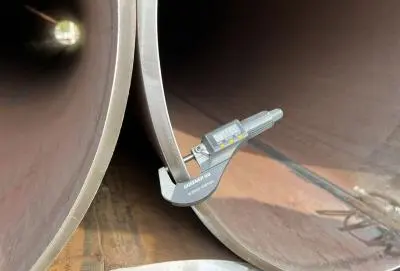
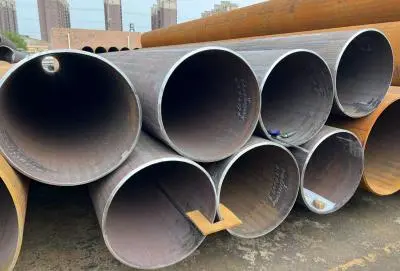
ISO 3183 L245 pipe is the international standard for steel line pipes used in systems that move oil and natural gas. The "L" prefix means it is for line pipe service, and "245" means it has a minimum yield strength of 245 MPa, the same as API 5L Grade B in the United States.
PSL 1 and PSL 2 Mechanical Benchmarks
The pipe has a minimum yield strength of 245 MPa, a minimum tensile strength of 415 MPa, and a minimum extension of 22% under PSL 1. These numbers show a grade that was made to be strong enough without having to pay more than microalloyed steels.
PSL 2 has stricter rules: the yield strength range is lowered to 245–440 MPa, the tensile strength range is raised to 415–655 MPa, there is a limit on the ratio of yield to tensile strength, the hardness can't be higher than 250 HV, and Charpy V-notch impact testing is required. When third-party checks are involved, PSL 2 is the standard level that most owner-operators need.
Chemical Composition and Weldability
The substance is low-carbon plain carbon steel that has no more than 0.28% carbon and 1.20% manganese. There is no need for expensive microalloying elements. The low carbon equivalent that this lean chemistry creates means that it is very easy to weld in the field, which is very helpful when your construction team is working hard to finish tie-ins on time. Cold bending is also easy, which cuts down on fabrication downtime on-site.
Comparing ISO 3183 L245 Pipe with Other Grades and Standards
It takes more than matching a yield strength number to a document to choose the right grade. When you compare pressure ratings, chemical limits, and service area suitability between ISO 3183 L245 pipe and grades that are close by, you can see the actual differences.
L290, which is the same as API 5L X42, has a higher minimum yield of 290 MPa and is better for moderate-pressure gathering trunk lines than L245, which would need a wall thickness penalty. API 5L Grade B and ISO 3183 L245 are almost mechanically the same. The only difference is that ISO 3183 is the international version that is used for projects that follow IEC or European engineering frameworks.
ASTM A106 Grade B is a seamless carbon steel pipe that is mostly used for high-temperature applications and not for moving buried pipes. Choosing A106 for a long-distance buried gathering line adds extra costs that aren't needed, and it might not meet the standards for pipeline stability set out in ISO 3183's annex.
Options made of stainless steel are better at resisting rust, but they are much more expensive and need special welding techniques. For gathering service that isn't bad and at room temperature, that price isn't worth the extra money.
The most important procurement insight is that L245 fits into a clear niche. It works great for low-pressure oilfield gathering branch lines, water injection and sewage pipelines, and urban gas distribution networks that go a short distance. Trying to use it on high-pressure long-distance trunk lines goes against what it was made for.
Procurement Guide: How to Buy ISO 3183 L245 Pipe with Confidence
A structured approach is needed to find compliant ISO 3183 L245 pipe at a good price while still meeting project milestone dates. Most of the time, price per ton is not the deciding factor for experienced EPC procurement directors.
These are the important steps that keep the project's profit and quality sign-off safe:
- API 5L PSL 1/PSL 2 certification validity: Make sure the manufacturer's current API 5L license covers the time frame of your delivery. If an owner-operator check finds that a certificate has expired, it can stop material release and shorten your critical path.
- EN 10204 3.1 or 3.2 Material Test Certificates: Almost all project requirements call for MTCs that can be tracked. Check to see if the mill automatically issues 3.1 certificates and can handle 3.2 third-party witness inspections by SGS, Bureau Veritas, or TÜV.
- 100% NDT coverage: Most oil and gas projects need to do both ultrasonic testing and radiographic inspection of weld seams as a matter of course. Check to see if the maker can do in-line UT and ask for examples of NDT records from recent production runs.
- Lead time realism: Mills with enough stock can usually meet quoted lead times of 7–15 days for large-diameter, heavy-wall orders. However, it's best to check these times against actual production schedules instead of commercial estimates.
These steps, applied consistently during supplier qualification, reduce the probability of third-party inspection rejection and protect the 5–15% project margin that EPC contractors work to preserve.
Manufacturing and Welding: Ensuring Quality and Performance
The production route affects how uniform ISO 3183 L245 pipe is mechanically and how well it welds. When making L245, ERW (Electric Resistance Welded) is most common for small to middle diameters. LSAW (Longitudinal Submerged Arc Welded), on the other hand, is used for bigger diameters where wall thickness and pressure rating standards get tougher.
Raw Material Traceability
A legitimate producer gets hot-rolled coil or plate from recognized steel mills in the United States. Longma Group gets its raw materials from well-known companies like Shagang, Bao Steel, and HBIS. This makes sure that the chemistry stays the same from the heat to the finished pipe. Full traceability is recorded from the heat number of the raw material to the finished MTC. This is something that project QA/QC managers should require.
Weld Quality and NDT
Post-weld heat treatment evens out any leftover stresses in the seam area, which makes the metal stronger and more stable in its shape. Ultrasonic testing of the weld seam and hydrostatic pressure testing of each finished pipe length are both done at the same time during in-process inspection. When the project requirements call for an x-ray, the maker must provide trained radiographers and equipment that has been checked for accuracy. During the technical evaluation, buyers should ask for the manufacturer's Inspection and Test Plan (ITP) to see if the quality system meets the needs of the project.
Benefits and Applications of ISO 3183 L245 Pipe in B2B Industries
The lowest price, wide supply around the world, and ease of welding without the need for preheating are the strongest business arguments for ISO 3183 L245 pipe. For EPC contractors who are in charge of multiple jobs at the same time in different places, having a source that keeps ERW L245 in stock in common diameters avoids the risk of having to make a last-minute purchase.
Key application categories where this grade consistently performs:
- Oilfield gathering and water injection lines: For oilfield gathering and water injection lines, L245 works perfectly with low operating pressures and fluid compositions that aren't sour.
- Urban gas distribution networks: Short-distance, low-pressure city gas pipe systems can use this grade because it is easy to weld and there are a lot of fittings that are made to ISO 3183 standards.
- Industrial fluid transport: For non-corrosive process fluid lines in plant settings where structural stability is more important than pressure rating, use the grade's flexibility and easy coating compatibility with 3LPE or FBE systems.
The trade-off is acknowledged: L245 is unsuitable for high-pressure long-distance transmission lines where X65 or X70 would be the appropriate specification. Procurement professionals who understand this boundary select the grade deliberately, not by default.
Conclusion
ISO 3183 L245 pipe delivers a well-defined combination of cost efficiency, reliable weldability, and sufficient mechanical performance for low-pressure gathering and distribution service. PSL 2 requirements add the fracture toughness and traceability controls that project audits demand. Buyers who qualify suppliers rigorously—verifying API 5L certification validity, MTC documentation, NDT coverage, and lead time commitments—position their projects for clean third-party inspection outcomes. For EPC contractors running multiple pipeline projects, partnering with a single manufacturer capable of covering the full ISO 3183 grade range reduces procurement complexity across the project portfolio.
FAQ
What is the difference between ISO 3183 L245 and API 5L Grade B?
Both have the same mechanical features. When working on projects that follow European or IEC engineering models, ISO 3183 L245 pipe is the recommended metric-based international standard. API 5L, on the other hand, is the definition from the American Petroleum Institute. Either standard can be used for many projects, but the owner's detailed specification decides which one is required.
Can L245 pipe be used in sour gas service?
Standard L245 can't handle bad gas. For projects using H₂S-containing fluids, the pipe needs to meet the extra requirements of ISO 3183 Annex H (sour service designation), and the hardness controls need to be in line with NACE MR0175/ISO 15156.
What certifications should a qualified supplier hold?
At least a valid API 5L license, ISO 9001 quality management approval, and the ability to give out EN 10204 3.1 MTCs. For most project audits, working with SGS or Bureau Veritas as a third-party inspector is a must.
What are typical lead times for bulk L245 orders?
Lead times of 7–15 working days are possible for common sizes that are in stock. Heavy-wall or large-diameter custom orders may take 4–8 weeks, depending on how busy the mill is and how many orders are coming in at once.
Source Your ISO 3183 L245 Pipe from a Trusted Manufacturer — Contact Longma Group
Longma Group has manufactured certified ERW and LSAW steel pipes since 2003, supplying over 90 countries with API 5L and ISO 3183 L245 pipe supplier–grade quality backed by full MTC documentation, 100% NDT, and SGS/BV third-party inspection support. Our in-house capacity exceeds 1,000,000 tons annually. Send your project specifications and quantity requirements directly to info@longma-group.com or visit longma-group.com to request a quote today.








