
When you're sourcing line pipe for an oil and gas project, the standards printed on the mill test certificate matter as much as the steel itself. Two designations appear on virtually every RFQ that crosses a procurement desk: ISO 3183 L290 pipe and API 5L Grade X42. Understanding exactly how they compare — and where one outperforms the other — can protect your project schedule, satisfy third-party auditors, and sharpen your EPC profit margin.
The short answer is that both standards describe essentially equivalent material. ISO 3183 L290 pipe carries a minimum yield strength of 290 MPa, making it the direct metric counterpart to API 5L X42. The choice between them typically comes down to project jurisdiction, owner specification, and PSL level rather than raw mechanical performance. Read on to see which fits your pipeline best.
|
|
|

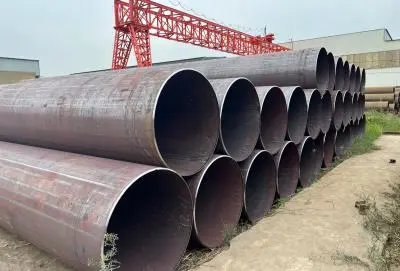
Understanding ISO 3183 L290 Pipe and API 5L Pipe Standards
What the Grade Designations Actually Mean
The International Organization for Standardization puts out ISO 3183, which sets the rules for steel pipe used in pipeline systems for oil and natural gas. The letter "L" stands for line pipe service, and the number "290" represents the lowest yield strength in megapascals. API 5L, which is put out by the American Petroleum Institute, uses the letter "X" before the yield strength in thousands of psi, so X42 is the same as ISO 3183 L290 pipe at about 42,100 psi (290 MPa).
A two-tier quality framework is used by both standards. PSL 1 is the standard for mechanical testing, chemical composition, and tolerances for size. Tougher chemical limits, a controlled yield-to-tensile ratio, Charpy V-notch impact testing, and a full hardness check are all part of PSL 2. It is almost always PSL 2 that is used for important transmission lines in the Middle East or South America.
Mechanical and Chemical Baselines
At least 290 MPa of yield strength and 415 MPa of tensile strength are achieved with L290/X42 under PSL 1. The yield window in PSL 2 is now 290–495 MPa and the tensile window is 415–565 MPa. The controlled ratio requirement that stops brittle fracture during pressure spikes is also added.
The chemical make-up of L290 is a low-carbon manganese steel. Under PSL 2, the maximum amount of carbon in seamless pipe is 0.22% and the maximum amount of carbon in welded pipe is 0.20%. This keeps the Carbon Equivalent (CE) low enough for safe field welding without pre-heating in most circumstances. Manganese can only be 1.20 percent or less, and trace grain-refining elements like niobium, vanadium, or titanium make the metal tougher without making it less flexible.
Key Differences Between ISO 3183 L290 and API 5L Pipes
Corrosion Resistance and Sour Service Compliance
Not all pipes meet the requirements of ISO 3183 or API 5L for use in hydrogen sulfide environments. For sour service compliance, extra tests are needed. ISO 3183 tells users to look at Annex H for HIC (Hydrogen-Induced Cracking) and SSC (Sulfide Stress Cracking) evaluations, and API 5L talks about SR15 and makes it compatible with NACE MR0175 and ISO 15156. When buying things for fields in Kazakhstan or Argentina's Patagonia, where the partial pressure of H₂ can be higher than 0.0003 MPa, procurement teams must make sure that these extra requirements are clearly stated on the purchase order.
Regional Acceptance and Regulatory Fit
It is widely known that API 5L works well with North American projects and users. European-bid projects, many Middle Eastern NOC specifications (including several ADNOC affiliates), and multilaterally funded infrastructure in Southeast Asia all use ISO 3183 as their main reference. As a result, many mills now dual-certify pipe to both standards at the same time. This means that the material test certificate (MTC) has both designations, which is a clean solution when the owner's specs refer to one standard and the contractor's internal quality management system refers to the other.
Cost, Lead Time, and Market Availability
The middle to low pressure service tier is where ISO 3183 L290 pipe does its job. Because it has a balanced strength profile, mills can use standard ERW or LSAW processes to make it without having to use complicated thermomechanical schedules. This keeps unit costs low. This grade is a good place to start for EPC contractors who want to improve their material margins by 5–15% before moving up to L360 (X52) or higher. When project deadlines are tight, lead times on stock-range OD and wall thickness combinations can be as short as seven days from a manufacturer with a lot of stock.
How to Choose the Best Pipe Grade for Your Pipeline Project?
It's not just a matter of picking the right line pipe grade; it's also a matter of managing risks that affects the schedule, the budget, and the contractor's responsibility. First, make a map of the working environment. This should include the design pressure, the range of operating temperatures, how aggressive the soil is, and any sour gas partial pressures. For oilfield gathering networks with medium to low pressure, short-distance onshore crude oil lines, or gas branch lines in mild areas with low H₂S exposure, ISO 3183 L290 pipe PSL 2 meets the technical needs at the lowest cost of any approved grade.
Supplier screening should be just as strict. These steps are the most important ones for making sure your project is safe:
- Confirm active API 5L certification: To do this, go to the API logo database and look up the certificate number, scope, and expiration date. If a certificate expires in the middle of a job, the audit will fail.
- Request EN 10204 3.1 or 3.2 MTC: Type 3.2 needs a countersignature from a third-party inspection, which is required for most projects reviewed by the NOC.
- Verify NDE coverage: Make sure that the weld seam goes through 100% ultrasonic testing (UT) and hydrostatic testing as required by the standard. Adding radiographic testing (RT) to the ends of the welds before field tie-in is another step.
- Assess third-party inspection readiness: Check the manufacturer's backing for SGS, Bureau Veritas, or owner-nominated inspectors on the shop floor to see if they are ready for a third-party inspection. At this point, responsiveness means that the delivery chain is fully developed.
Once you have qualified the provider, you need to find a balance between technical compliance and shipping processes. Your project's quality assurance chain will be easier if you work with a supplier that is certified by both ISO 3183 and API 5L, has in-house anti-corrosion capabilities (3LPE, FBE), and can show that their products have been tracked from raw material heat to finished pipe.
Practical Applications and Case Studies of ISO 3183 L290 and API 5L Pipes
It is well known that ISO 3183 L290 pipe has been used in a number of different types of pipelines. This grade is usually required for trunk lines that work below 7 MPa design pressure in the Permian Basin and Middle Eastern oilfields where gas gathering systems are located on land. Its weldability profile—low CE, normalized, or thermomechanically rolled delivery condition—lowers the cost of consumables and the risk of rework during field girth welding. This saves real money on projects with hundreds of kilometers of right-of-way.
In the middle of the 20th century, API 5L X42 was one of the first high-strength line pipe grades used by the American gas business. It is still the main material used to replace old distribution systems across North America. Its ISO 3183 cousin has become more popular in Asian and African pipeline bids since ISO 3183 was revised in 2007. This made the two papers much more similar. Today, for EPC workers who work all over the world, dual-certified pipe is the standard rather than the exception.
Where and How to Procure Certified ISO 3183 L290 and API 5L Pipes
Teams in charge of buying things should give preference to companies that have a current API 5L monogram license, quality management systems that are ISO 9001-certified, and can provide all project paperwork in a single tracked package, including ITP, MPS, MTC, dimensional inspection reports, and NDE records. Factory inspections by the owner or a chosen third party before an order is placed are still the best way to find out about the factory's production skills and quality culture.
Conclusion
The minimum yield stress for ISO 3183 L290 pipe is 290 MPa, the minimum tensile stress is 415 MPa, and both API 5L X42 and L290 pipe have a known chemistry that works well for medium to low pressure pipeline service. Which one to choose depends on the project's jurisdiction, the owner's requirements, and whether sour-service supplementary requirements are present. Dual-certified pipe that meets both standards at the same time is the safest way for most EPC contractors to buy materials in the Middle East, Southeast Asia, or South America. Before giving out any buy orders, make sure you know the PSL level, the MTC type, and the third-party review access.
FAQ
What is the difference between ISO 3183 L290 and API 5L X42?
In terms of mechanics, they are the same. ISO 3183 L290 pipe is the ISO metric code, and X42 is the API imperial code. A lot of mills certify to both on the same MTC.
Does L290 qualify for sour service automatically?
No, to meet the requirements for sour service, you need to use extra requirements like ISO 3183 Annex H or API 5L SR15 and test the pipe for HIC and SSC according to NACE MR0175 and ISO 15156.
What is the difference between PSL 1 and PSL 2 for this grade?
PSL 1 includes basic standards for size and strength. Charpy impact testing, hardness checking, stricter chemical limits, and a controlled yield-to-tensile ratio are all added to PSL 2.
What delivery conditions are available for L290 pipe?
As-rolled (AR), Normalized (N), and Thermomechanically Rolled (M) are all common shipping states. The "M" condition has the best low-temperature toughness and the best grain structure.
What documentation should I require from the supplier?
You must have at least EN 10204 3.1 or 3.2 MTC, records of hydrostatic tests, full NDE reports (UT/RT), a dimensional inspection report, and a copy of the mill's current API 5L license.
Get Certified ISO 3183 L290 Pipe from Longma Group
Since 2003, Longma Group has been making ERW and LSAW steel pipe and has sent approved API 5L PSL1/PSL2 and ISO 3183 L290 pipe to more than 90 countries. We produce more than a million tons of goods every year, and we offer full project documentation in the forms of ITP, MPS, and EN 10204 3.2 MTC. We also offer third-party inspection by SGS or Bureau Veritas. As a reliable supplier, we offer quick turnaround times and expert help in English. Send us your RFQ today by emailing info@longma-group.com or going to longma-group.com.








