
Sourcing ISO 3183 L320 pipe for an EPC pipeline project carries real financial and contractual risk. One wrong supplier decision—whether a lapsed API certificate, a missed delivery window, or a failed third-party weld inspection—can derail a project milestone and erode your profit margin. This guide walks procurement directors through the exact checkpoints that separate a dependable exporter from a costly mistake, covering technical specifications, grade comparisons, supplier vetting criteria, and quality assurance protocols you need before committing to any purchase order.
|
|
|
ISO 3183 L320 Pipe Specifications and Standards
What "L320" Actually Means for Your Pipeline Design
Under PSL 1, ISO 3183 L320 is the grade for metric line pipes. It has a minimum yield strength of 320 MPa and a minimum tensile strength of 435 MPa. The name is the exact same as API 5L Grade X46. This is something you should check if your owner's technical specification talks about either standard. The yield range narrows to 320–525 MPa and the tensile range to 435–655 MPa under PSL 2. Charpy V-notch impact testing must be done at 0 °C or -20 °C, based on the design temperature zone. If you are building in the north onshore or any other area where crack toughness is a contract condition, that smaller envelope is important.
Chemical Composition and Weldability
Strength and field weldability are both good in L320's alloy profile. Manganese content can go up to 1.30 percent, and niobium (Nb) and titanium (Ti) can be added in small amounts to improve low-temperature toughness and grain structure without raising the carbon equivalent (CEQ) above 0.43. Keeping CEQ below that level stops cold cracking while girth welding on-site, a problem that can lead to expensive repair processes and delays in hydrostatic testing. When you look at a mill test certificate (MTC), make sure that the CEQ formula (IIW or Pcm) that is listed fits the one that is in your welding process specification.
Manufacturing Process and Delivery Condition
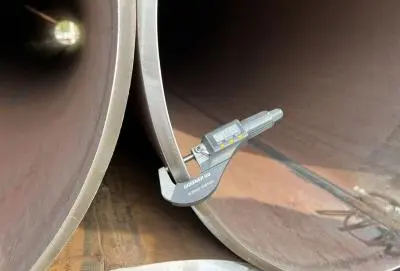
Depending on the width and wall thickness needs, ISO 3183 L320 pipes are made using either ERW (Electric Resistance Welded) or LSAW (Longitudinal Submerged Arc Welded). Toughness changes in sub-zero service depending on whether the delivery condition is Normalized (N) or Thermo-Mechanically Rolled (M). The N and M delivery versions work consistently in fairly cold areas, which makes L320 a good grade for onshore gathering lines in places where winters are mild and below zero.
Evaluating and Comparing ISO 3183 L320 Pipes with Alternative Grades
Picking the right grade requires weighing the costs and benefits. L290 (X42) has a lower minimum yield strength, which means that bigger walls are needed to get the same hoop stress grade. This makes the material heavier and costs more. As you move up to L360 (X52), the yield strength goes up, but the weld process gets more complicated, and hydrogen-induced cracking (HIC) can happen more easily in some sour-service conditions if the chemistry isn't carefully controlled. For medium-pressure gathering trunklines, wellhead manifold pipe, and regional natural gas transfer lines where better grades aren't worth the extra cost, L320 is a good middle grade.
Because it can handle more pressure than L290, the wall thickness can be thinner. This makes the pipe lighter and lowers the costs of transporting and installing it, which adds up to real savings over a long trunkline. Because it saves money, ISO 3183 L320 pipe is the best gathering grade for projects that want to find a mix between wall thickness and total fixed cost.
What to Check When Choosing an ISO 3183 L320 Pipe Exporter
Checking out an exporter is more than just reading a product datasheet. The following list shows the standards that skilled QA/QC managers use during technical evaluations and mill qualification audits.
Before sending out an RFQ, every procurement team should make sure of the following:
- Valid API 5L License: Check the API website to see the license number and make sure the expiration date covers the whole project delivery window, not just the order date. If your license has expired or been banned, the monogram marking on each pipe joint is no longer acceptable.
- EN 10204 3.1 or 3.2 MTC Availability: Most PSL 2 projects need 3.2 certification, which means that the heat and test reports are co-signed by an independent third-party inspection from SGS, Bureau Veritas, or a similar company. Ask for examples of MTCs from past orders to check the style and level of tracking.
- 100% NDT Coverage: Make sure the mill tests the weld seam with ultrasonic waves (UT) and every pipe joint with hydrostatic pressure, not just a few at a time. For systems that use sour services (H₂), HIC and SSC testing according to NACE MR0175 and ISO 15156 should be a line item in the contract.
- Third-Party Inspection Access: A trustworthy exporter will let owner- or buyer-selected inspectors (SGS, BV, Intertek) come to the mill. Reluctance to allow review is a red flag during the expert evaluation process.
- Delivery Lead Time and Stock Position: If you need to move quickly on a project, ask the exporter if they have certified stock in standard sizes. Having a provider that can quickly send stocked sizes in 7 days can help keep your project on plan when there are problems with getting the materials.
All of these steps give your technical evaluation group a factual way to score suppliers instead of just looking at price.
Ensuring Product Quality and Risk Mitigation Before Placing an Order
When buying ISO 3183 L320 pipe, quality problems usually happen in four areas: the integrity of the weld seam, measurements that don't match up, missing paperwork, and damage to the coating during transport. It is cheaper to deal with each one legally and formally before placing an order than to deal with a field rejection.
Before signing the contract, you should ask for the supplier's Inspection and Test Plan (ITP) and Manufacturing Procedure Specification (MPS). Check to see if the ITP matches the hold points and witness points that were set out in the Quality Plan for your project. Any changes to the number of tests or the criteria for acceptance should be made in writing before production starts, not during the final inspection.
In the purchase order, you should include information about bare-pipe end protectors, the right way to bundle pipes, and how to handle them. Damage during transit to pipe bevels or anti-corrosion coatings (3LPE, FBE) causes delays in repair or replacement that cost a lot of money at the receiving yard. By requiring pictures of full containers before they leave, an audit record is made that can be used to back up any shipping damage claims.
Applications and Long-term Value of ISO 3183 L320 Pipes in Your Projects
ISO 3183 L320 pipe works well for medium-pressure natural gas gathering systems, onshore water injection headers in oilfield secondary recovery operations, and regional transmission corridors in places where winter temperatures are mild and don't drop below zero. Its flexibility lets it be bent in the field to follow the terrain without having to be heated up first, which lowers the cost of field welding on cross-country routes.
If you add external anti-corrosion systems like 3LPE or FBE coats and cathodic protection to L320 pipes, they usually last longer than 30 years. So, choosing the right pipe grade during procurement has a triple benefit: thinner walls reduce the amount of material needed, proper sour-service qualification lowers the risk of failure in service, and full documentation traceability speeds up the approval and insurance processes across multiple project jurisdictions.
Conclusion
To order certified ISO 3183 L320 pipe, you have to go through a series of checks, such as making sure the API 5L license is still valid and that the documentation meets MTC standards. You also have to make sure that a third party can inspect the pipe and that delivery dates are reasonable. Skipping any of these steps adds to the risk of missing deadlines and poor quality, which gets worse as the project moves into construction. For medium-pressure transfer and gathering, this grade has been shown to be a good mix of pressure performance, weldability, and cost-effectiveness. A good specification turns into a successfully delivered pipeline when that material quality is matched with an exporter whose manufacturing credentials can be checked and who provides quick technical support.
FAQ
Is ISO 3183 L320 the same as API 5L X46?
Yes, Grade X46 under API 5L and L320 under ISO 3183 are practically the same. They both need a minimum yield strength of 320 MPa. Pipes that are dual-certified to both standards can be used for projects that need them. This makes third-party audit documentation easier.
What documentation should I require from an L320 pipe exporter?
Ask for the API 5L license copy, the EN 10204 3.1 or 3.2 MTC for each heat test, the hydraulic test records, the UT/RT inspection reports, and the measurement inspection records at the very least. According to NACE MR0175, for sour-service apps, you should add HIC and SSC test results.
Can L320 pipe be used in H₂S sour-service conditions?
Yes, as long as it is made to PSL 2 standards and meets the HIC and SSC resistance requirements set by ISO 15156 and NACE MR0175. It's not enough for standard PSL 1 pipe to be qualified for sour service; this must be clearly stated in the purchase order and confirmed by testing by a third party.
What anti-corrosion coating options are available for L320 line pipe?
Three-Layer Polyethylene (3LPE), Fusion-Bonded Epoxy (FBE), and Two-Layer Polypropylene (2PP) are common surface coating methods. The choice is based on the working temperature, the land conditions, and the needs of the owner.
Partner with Longma Group for Your Next L320 Procurement
Since 2003, Longma Group has been making ISO 3183 L320 pipe supplier-grade ERW and LSAW steel pipes and sending them to more than 90 countries. Each year, they are confirmed to produce more than 1,000,000 tons. For your scientific review, you can look at our API 5L license, ISO 9001 certification, and full EN 10204 3.1/3.2 MTC documentation. Third-party inspectors chosen by the owner are welcome, and we offer full ITP and MPS packages for EPC project audits. To get a quote today, email your project details to info@longma-group.com or go to longma-group.com.








