
If you've ever worked through a pipeline project specification and landed on the grade designation "L450," you've encountered one of the most widely specified line pipe grades in the global energy sector. Understanding exactly what this designation means — and why it matters for your procurement decisions — can save time, reduce technical risk, and help you hold your supply chain accountable. In short, ISO 3183 L450 pipe is a carbon steel line pipe grade defined under the ISO 3183 standard for petroleum and natural gas transportation systems. The "L" stands for Line Pipe, and "450" refers to the minimum yield strength of 450 MPa (approximately 65,300 psi). This grade is technically equivalent to API 5L X65, making it directly interchangeable in most project specifications. It is the go-to grade for long-distance onshore gas transmission, medium-pressure crude oil lines, and high-pressure urban gas distribution networks.
|
|
|
Understanding ISO 3183 and the Significance of L450
What ISO 3183 Actually Covers
Within the oil and natural gas businesses, ISO 3183 sets the rules for steel pipes used in pipeline transportation systems. It sets standards for the chemistry of materials, their mechanical performance, dimensional limits, testing, and paperwork. It was made by the International Organization for Standardization. It is required by most national oil companies and EPC contractors in the Middle East, Southeast Asia, and South America, or they accept it as the same thing as API 5L.
How the "L" Grade System Works
The minimum yield strength in megapascals is shown by the letter "L" before the grade number. At 245 MPa, L245 is the first in the line. It goes through L360, L415, L450, L485, and finally L555. As you go up, the pressure-bearing ability goes up, but the cost of the materials goes up, and the welding rules get tighter. The design pressure, pipe diameter, wall thickness, and operating environment all play a direct role in choosing the right grade.
Where L450 Sits in the Grade Hierarchy
L450 is in a healthy spot in the middle to high strength range. It has enough yield strength to lower wall thickness in high-pressure systems, which lowers the weight of the material and the cost of transporting it. At the same time, it has low enough carbon equivalent values to allow for simple field girth welding. Compared to L485 and L555, welding supplies for L450 are much easier to find around the world. This is very important for construction projects in Central Asia or South America's interior.
Key Specifications and Properties of ISO 3183 L450 Pipes
Chemical Composition
The steel used in L450 is a low-carbon microalloyed steel, which usually has a carbon content of less than 0.22% and a manganese content of up to 1.60%. Small amounts of niobium, vanadium, and titanium (Nb/V/Ti) are added to smooth out the grain structure and make the material tougher without making it harder. There are strict limits on sulfur and phosphorus levels. Low sulfur levels directly lower the chance of hydrogen-induced cracking in slightly sour conditions.
Mechanical Performance
The mechanical floor for L450 is clear: it has to have a minimum yield strength of 450 MPa, a minimum tensile strength of 570 MPa, and a minimum elongation of 21% or more. Charpy V-notch impact testing is needed for PSL 2 approval, and the material keeps its impact energy fixed from room temperature to -40 °C. The Drop Weight Tear Test (DWTT) results support crack arrest behavior, which is important for ISO 3183 L450 pipes in permafrost regions.
Manufacturing and Quality Control
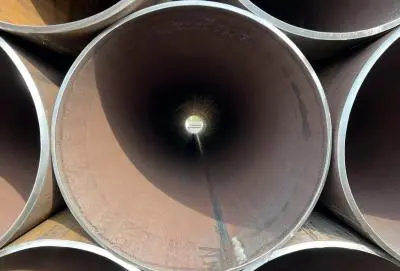
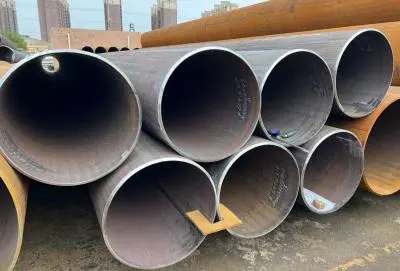
There are two main types of L450 pipes: small-diameter seamless pipes and large-diameter longitudinal submerged arc welded (LSAW) pipes. ME (as-rolled) and QE (quenched and tempered) are two delivery conditions. QE offers better low-temperature toughness consistency. As part of quality assurance, the weld joint is tested with ultrasonic waves (UT), full-body X-rays (RT), hydrostatic pressure, and measurements to make sure the pipe ends are straight and not out of round so they can be fitted correctly in the field.
Comparing ISO 3183 L450 with Other Pipe Grades
L450 vs. Lower Grades: L360 and L415
L360 and L415 are often used in systems that send and collect water at low pressure. When operating pressures go above what these grades can handle efficiently, the walls are made thicker to make up for it, which adds weight and cost. Engineers can use less wall thickness for the same pressure ratings with L450, which saves material on large-diameter, long-distance projects.
L450 vs. Higher Grades: L485 and L555
L485 and L555 are stronger, but they have tighter rules about how to weld and heat treat after welding. Field workers who work in remote areas often have a hard time finding welding supplies that work with these grades. L450 doesn't have this problem because its welding process specs are stable, its consumables are available all over the world, and its coating compatibility with FBE and 3PE systems is well-established. This makes it the best grade for onshore trunk lines where building logistics are important.
L450 vs. API 5L X65 and ASTM A106
Technically, L450 and API 5L X65 are the same thing, and most project specifications will accept either name. ASTM A106, on the other hand, is a standard for pressure vessels and process pipes, not line pipes. It also doesn't have the same approval process for long-distance transfer service. ISO 3183 PSL 2 or API 5L PSL 2 certification is the right way to go for EPC projects that need audit documentation from a third party.
Practical Applications and Benefits of ISO 3183 L450 Pipes
Where L450 Is Specified Most Often
Onshore natural gas main pipes, high-pressure gas distribution networks in cities, oilfield gathering systems, and medium-pressure crude oil transport lines all use L450 as their main grade. Because it is strong, tough, and has a chemical makeup that makes it easy to weld, it works really well for big infrastructure projects where hundreds of kilometers of pipe need to be welded in the field.
Because it improves speed so much, a lot of people use it:
- Cost-effective strength ratio: L450 achieves the pressure ratings needed for most onshore gas trunk lines at lower material and fabrication costs than L485 or L555. Thinner walls reduce both ISO 3183 L450 pipe weight and transportation expenses per kilometer.
- Sour service adaptability: PSL 2 grade L450 can be specified with supplementary requirements for mild sour oil and gas environments with low H₂S content, aligned with NACE MR0175 guidance for low-severity sour conditions.
- Coating compatibility: L450 is fully compatible with FBE (fusion-bonded epoxy) and 3PE (three-layer polyethylene) external anti-corrosion systems, as well as internal drag-reducing agent coatings — both standard on modern long-distance transmission pipelines.
Because of these factors, buying teams have a scientifically sound and financially sensible choice for most onshore pipeline projects. The grade does have clear limits. It shouldn't be used in ultra-high-pressure deep underwater situations, places colder than −45 °C, or high-sulfur, sour service conditions that need stricter material grades.
Documentation and Audit Compliance
There is a full documentation chain for EPC contractors that have to go through third-party inspection by the owner. This includes EN 10204 3.1 or 3.2 Material Test Certificates (MTC), Inspection and Test Plans (ITP), and third-party verification reports from groups like SGS or Bureau Veritas. These are all standard requirements in most project technical specifications.
How to Procure ISO 3183 L450 Pipes: Tips for B2B Buyers
Certifications to Verify Before Shortlisting
Before sending an RFQ, make sure that the manufacturer has a valid API 5L license that covers both PSL 1 and PSL 2 and that the certificate is still valid until the end of the project delivery window. Get the ISO 9001 quality management certificate and make sure it is still valid. Ask the plant directly if owner-witnessed inspection is possible, as many project contracts need a resident third-party tester to be present during production.
Evaluating Suppliers on Technical Depth
An honest ISO 3183 L450 pipe maker should be able to show full heat and lot traceability, from mill certificates for the raw materials to paperwork for the final pipes. Check to see if the supplier gets the plate or coil from well-known steel mills. The place where the raw materials come from has a direct effect on how consistent the chemical and mechanical properties are. Suppliers who can name raw material sources, like Baosteel, HBIS, or Shagang, show a level of supply chain responsibility that helps with audit compliance further down the line.
Lead Time and Logistics Realities
For big trunk line projects, it usually takes four to eight weeks to make large-diameter, thick-wall L450 pipes after the order is placed. Early on in the RFQ process, make sure you know the supplier's production plan and stock level. Some makers keep some standard-sized parts in stock so that they can ship within seven days for project goals that need to be met quickly. This is a big help when project schedules get tight.
Conclusion
ISO 3183 L450 pipe says that L450 is a well-proven, technically balanced grade that meets most of the needs of onshore oil and gas pipelines. It is the standard for long-distance gas transmission and medium-pressure crude systems because it has a minimum yield strength of 450 MPa, a low-carbon microalloyed chemistry, and PSL 2 toughness performance. For EPC procurement teams, the grade's stable welding environment and wide range of coating compatibility lower the risk of execution in the field without lowering the performance of the structure. To make sure a project is compliant, it is best to choose a maker whose licenses can be checked, whose raw materials can be tracked, and whose support for third-party inspections has been shown.
FAQ
1. Is L450 the same as API 5L X65?
Yes, properly speaking, L450 and X65 are the same grade. L450 is the ISO 3183 number, and X65 is the API 5L number. Both need to have a minimum yield strength of 450 MPa and similar standards for stiffness and chemistry. Either name will work for most project requirements.
2. What is the difference between PSL 1 and PSL 2 for L450?
The basic conditions for chemistry and mechanical properties are set by PSL 1. In PSL 2, Charpy impact testing, DWTT testing, stricter chemical limits, and tighter controls on carbon equivalent are all required. This makes it the level needed for most oil and gas transmission applications.
3. Can L450 PSL 2 be used in sour service?
L450 PSL 2 can be used in mildly sour environments with low H₂S levels, which is in line with NACE MR0175 guidelines for low-severity conditions. For service with a lot of sulfur or sourness, a different material specification is needed.
4. What NDT is required for ISO 3183 L450 pipe?
Full-body acoustic testing of the weld joint, radiographic testing, and hydrostatic pressure testing are all standard NDT for L450. In addition, PSL 2 needs Charpy and DWTT tests with recorded results on the MTC.
5. How do I verify a supplier's API 5L certification?
You can look at the API nameplate license information on the API website itself. Make sure the license covers the right grade and PSL level, and make sure the expiration date goes past the time you plan to deliver.
Request a Quote for Certified L450 Line Pipe — Longma Group
Since 2003, Longma Group has been making steel pipes that are approved by API 5L and ISO 3183 for projects in more than 90 countries. If you need an ISO 3183 L450 pipe supplier you can trust, we offer full PSL 1 and PSL 2 compliance, EN 10204 3.1/3.2 MTCs, 100% UT/RT inspection, and third-party verification support with an owner present. You can get in touch with our technical team at info@longma-group.com to get a price or look through our collection of approved products.








