
Refineries run hot, pressurized, and chemically aggressive around the clock. When a piping system fails under those conditions, the consequences go far beyond a production halt. So what material actually holds up? The answer, in many critical process lines, is the ASTM A691 5Cr pipe — an electric-fusion-welded (EFW) alloy steel pipe built from pressure-vessel-grade plate containing roughly 5% chromium and 0.5% molybdenum. It handles high-temperature sulfidation, hydrogen attack, and creep degradation where carbon steel simply cannot. In this article, I'll break down exactly where and why this alloy earns its place inside a refinery.
|
|
|
Understanding ASTM A691 5Cr Pipe: Chemical and Mechanical Foundations
Chemical Composition That Matters
The chemistry of 5Cr-0.5Mo is not just a guess. A chromium content of 4.00% to 6.00% creates a protective oxide layer that stops sulfidation and oxidation at high temperatures. When molybdenum is kept between 0.45% and 0.65%, it tightens the grain structure and raises the creep strength. Creep strength is the ability to resist slow deformation under constant heat and load. Together, these two things make the metal work in places where carbon steel would rust in months.
Mechanical Properties You Can Count On
The tensile strength of ASTM A691 5Cr pipe must be at least 60 ksi (415 MPa), and the yield strength must be at least 30 ksi (205 MPa). These numbers don't change when the temperature changes, which is exactly what happens to refining process lines when they start up, shut down, and have process problems. The pipe also keeps its good elongation, which means it can handle mechanical stress without breaking suddenly. This is a very important quality for high-pressure service.
Heat Treatment and Class Designations
The "Class" method in ASTM A691 tells us what needs to be done for post-weld heat treatment (PWHT) and radiography testing (RT). For Class 22, you need to relieve stress and do spot RT. For Class 42, you need to do standardized and adjusted heat treatment plus 100% RT. For the 5Cr grade, PWHT is required because it cools the martensitic weld zone, making the metal more flexible and lowering the stress that is still there. If you skip this step, the weld will be hard and brittle, and it will eventually break from thermal fatigue.
Critical Application Areas of ASTM A691 5Cr Pipe in Refineries
It is the 5Cr-0.5Mo metal that forms in certain places where the work climate is hot and chemically harsh. This material is needed in the following main service areas.
- Hydrocracking and Hydrotreating Units: Process temperatures in these units regularly exceed 400°C (750°F), and the streams carry dissolved hydrogen and hydrogen sulfide. The 5% chromium content provides the sulfidation resistance needed to survive these conditions over a design life measured in decades, not years.
- Catalytic Reforming Lines: Reformer feed and effluent piping sees cyclic thermal stress combined with hydrogen partial pressures high enough to cause hydrogen embrittlement in lower-alloy materials. The 5Cr-0.5Mo grade resists this attack while meeting the pressure ratings required by ASME B31.3 process piping codes.
- Furnace Tubing and Heat Exchanger Bypass Systems: Fired heaters and heat exchangers subject piping to sustained high-temperature exposure. Creep is the failure mode here — slow plastic deformation that eventually ruptures the pipe wall. The molybdenum addition in this alloy significantly raises the creep-rupture strength compared to plain 2.25Cr-1Mo grades.
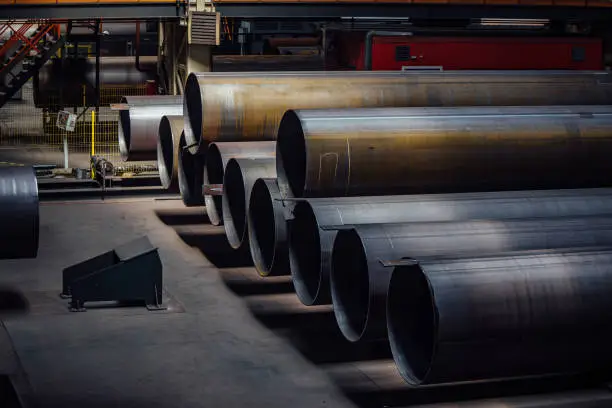
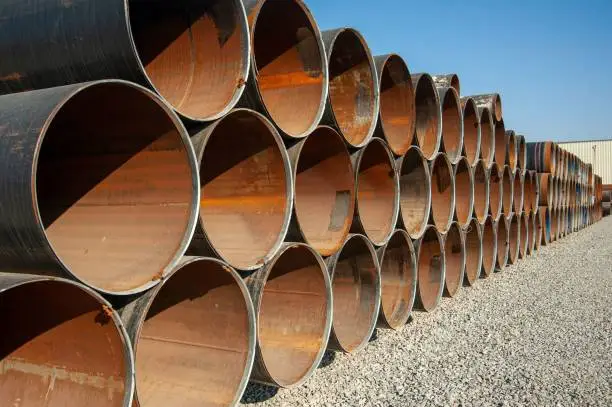
- Large-Diameter Process Headers (φ457–1422 mm): Seamless pipe manufacturing has practical diameter limits. Above roughly 24 inches, EFW construction becomes the only feasible route. ASTM A691 5Cr pipe fills this gap directly, providing large-diameter, heavy-wall piping with the same alloy chemistry as a smaller seamless alternative.
One thing that all of these service areas have in common is that the cost of a pipe failure is much higher than the cost of choosing the right material from the start.
Comparing ASTM A691 5Cr Pipes with Other Pipe Grades Used in Refineries
ASTM A335 P5 (Seamless) vs. ASTM A691 5Cr (EFW)
Since both grades are made of 5Cr-0.5Mo, their corrosion resistance is the same. The difference is how they are made. ASTM A335 P5 is seamless, which means that the largest diameter that can be used is about 24 inches. This makes it hard to find materials for large-bore orders. EFW makes ASTM A691 5Cr pipe from pressure-vessel plate. It has controlled wall thickness and sizes ranging from 18 inches to more than 56 inches. For large-diameter refinery heads, A691 is the most useful standard.
9Cr-1Mo (Grade 91) vs. 5Cr-0.5Mo
Grade 91 pipe has a higher creep strength and is used for ultra-high-temperature steam service at temperatures above 1050°F (565°C). It is, however, a lot more expensive and needs stricter PWHT limits. For hydroprocessing work in refineries between 370°C and 500°C, the 5Cr-0.5Mo alloy is the best choice because it is both cost-effective and technically correct. When you over-specify to Grade 91, you add cost without adding any function.
Carbon Steel vs. 5Cr-0.5Mo in Sulfur-Rich Environments
The Nelson Curves (API RP 941) say that carbon steel can be damaged by high-temperature hydrogen attack (HTHA) at normal temperatures and hydrogen partial pressures that happen during hydrotreating. On these curves, the 5Cr-0.5Mo alloy is well above the carbon steel limit. This is why it is listed in so many refining pipe material standards (PMS) for hydroprocessing service.
Procure with Confidence: Sourcing ASTM A691 5Cr Pipes for Your Refinery Projects
Documentation Is Non-Negotiable
A good supplier will supply you with EN 10204 3.1 or 3.2 material test certificates (MTC), complete heat/lot traceability from plate to end pipe, documented PWHT records and complete NDE reports including radiography and ultrasonic testing of the weld seam for 100% of the report. As part of the technical examination, procurement teams should additionally request to see the weld process specification (WPS) and procedure qualification record (PQR).
Quality Verification and Third-Party Inspection
For large EPC projects, third party inspection is generally required such as Bureau Veritas, SGS, or TüV. Good manufacturers will allow the inspectors to stay at the mill during the making of the goods. A record of hydrostatic testing of each length of pipe is required and a hardness test at the weld zone verifies the PWHT is good. These are basic criteria, not high-end services. A supplier that doesn’t meet them is a sourcing risk.
Supplier Qualification Checklist
Before sending a buy order, make sure the following things about the seller are always true:
- ISO 9001 certification covering pipe manufacturing and NDE processes
- API 5L license as evidence of documented quality system maturity
- In-house RT and UT equipment with calibrated operators
- Mill plate sourcing from recognized steel producers with traceable heat numbers
- Demonstrated large-diameter capability (φ457 mm and above)
- Ability to produce custom lengths to match spool fabrication requirements
By checking these things during the seller qualification stage, the project won't be held up by materials being rejected during the getting inspection stage.
Manufacturing and Quality Assurance of ASTM A691 5Cr Pipes
EFW Manufacturing Process
Pressure-vessel-grade plate is rolled into a cylinder shape and the lengthwise seam is welded using submerged arc welding (SAW) with filler metal that has the same 5Cr-0.5Mo makeup. This makes ASTM A691 5Cr pipe. A691 is different from the A671/A672 series because the standard calls for extra filler metal to be used in the weld. The pipe goes through PWHT in a controlled oven after welding to make the weld composition the same as the base metal.
Nondestructive Testing Protocol
It is required that all weld seams in an ASTM A691 5Cr pipe made to Class 42 be x-rayed. This is not a sample method; every inch of the weld is looked at. Extra ultrasound testing looks for flaws in the plate's smooth flow and breaks in the fusion line that RT might miss. This two-way NDE procedure is the reason why A691 Class 42 is often mentioned in EPC procurement requirements for vital service.
Raw Material Traceability
Each length of pipe is linked to a unique plate heat number, which is then linked to the steel mill's ladle analysis and mechanical test results. This chain of responsibility meets the documentation needs of both ASME B31.3 and project-specific PMS needs. No matter how good the pipe is, losing this chain at any point in the supply process is a quality failure.
Conclusion
As the name suggests, ASTM A691 5Cr pipe is used in refineries for a specific purpose: it is used in high-temperature, hydrogen-rich, sulfur-bearing service where carbon steel corrodes and 9Cr metals are too specific. The molybdenum adds resistance to creep, the chromium at 5% prevents sulfidation, the EFW structure allows for big diameters, and the Class 42 NDE process makes sure the weld is as strong as the base metal. This metal grade is the best choice for EPC procurement teams that need to make pipe material requirements for hydroprocessing, catalytic reforming, or fired-heater service because it is both technically sound and cost-effective.
FAQ
How does ASTM A691 5Cr pipe differ from ASTM A335 P5?
They are both made of 5Cr-0.5Mo, but A335 P5 is seamless and A691 is EFW.
Is PWHT mandatory for the 5Cr grade?
Yes. When you weld this alloy, you get a martensitic weld zone that is tough and breaks easily. PWHT softens that structure, making it more flexible again. Skipping it goes against both the norm and ASME B31.3.
What Class should I specify for critical service?
Class 42 is the level for service in important refineries. It needs a stabilized and tempered heat treatment, as well as a full x-ray of the weld line.
Can this material be used in sour service (H₂S environments)?
Yes, as long as the controls for hardness meet NACE MR0175/ISO 15156. To make sure agreement, the hardness of the weld zone must be checked after PWHT.
What filler metal is used during welding?
The filler has to be the same 5% Cr, 0.5% Mo mix. To keep the weld chemical the same as the base plate, most people use E8018-B6 electrodes or similar SAW wire/flux combinations.
Get ASTM A691 5Cr Pipe Directly from a Trusted Manufacturer
Since 2003, Longma Group has sold EFW alloy steel pipe to engineering firms in more than 90 countries. As an ASTM A691 5Cr pipe provider, we can work with diameters from φ457 mm to φ1422 mm. We offer full EN 10204 3.1/3.2 MTC paperwork, 100% RT/UT inspection, and third-party inspection support. To get a price for your project, email our expert team at info@longma-group.com or go to longma-group.com.