
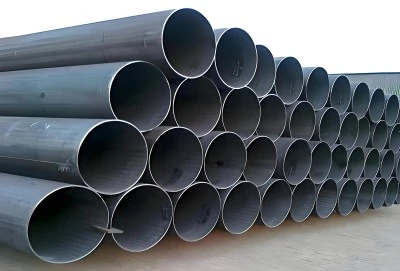
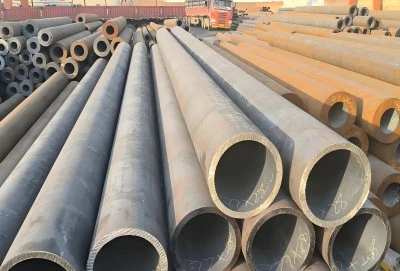
The EN10219-1 S235J2H pipe is a cold formed welded structural hollow section that falls under the European standard EN 10219-1. The identification is broken down as follows: 'S' stands for structural steel, '235' specifies a minimum yield strength of 235 MPa, 'J2' requires Charpy V-notch impact testing at -20°C with a minimum energy absorption of 27 Joules, and 'H' defines the hollow section geometry. J2H is the most low-temperature robust S235 sub-grade and is therefore the material of choice for structural work in cold climes and other challenging settings where brittle fracture is a genuine problem.
|
 |
|
Understanding EN10219-1 S235J2H Pipe Specifications
Before engineers and buying teams can define a structural hollow section, they need to be sure they understand what the numbers and letters mean. This grade is part of a clear set of technical rules that cover everything from chemical limits to allowed tolerances in size.
Chemical Composition
S235J2H has minimal compounds, intentionally. The maximum amount of carbon is 0.17% which immediately improves the quality of the weld by reducing the roughness of the heat affected zone. Manganese can be as high as 1.4% and the silicon is controlled to avoid issues during hot-dip galvanising. This material is stronger since the phosphorus and the sulphur are limited to 0.035%. Under most normal conditions this balanced mix means that the fabrication teams in the workshop can weld, cut and drill pieces without having to do anything specific to get them hot beforehand.
Mechanical Properties
The tensile strength of the EN10219-1 S235J2H pipe is 360–510 MPa, and the yield strength is at least 235 MPa for thicknesses up to 16 mm. It can be stretched a minimum of 26% of its length before it breaks hence it is incredibly flexible. The most essential mechanical property is the J2 impact requirement, which states that three Charpy samples tested at -20°C must have no less than 27 Joules. This is not an arbitrary aim. It is a must pass/fail requirement that is verified on every output heat.
Dimensions and Tolerances
EN 10219-2 contains requirements for wall thickness, out-of-roundness, straightness and mass per unit length. This includes the control of dimensions. You must follow the corner radius criteria for both square and rectangular hollow sections (SHS/RHS). Tight tolerances are critical in modular construction and steel prefab frames, because how the pieces fit will directly effect the speed of assembly and the quality of the on-site welding.
Comparing S235J2H with Other Steel Grades for Structural Pipes
Cost and effectiveness must be weighed when picking the right sub-grade. The table below shows where S235J2H stands in relation to its closest neighbors. It shows the grade, the impact test temp, the minimum yield (MPa), and the typical cost index.
| Grade | Impact Test Temp | Min. Yield (MPa) | Typical Cost Index |
|---|---|---|---|
| S235JRH | +20°C | 235 | Low |
| S235J0H | 0°C | 235 | Medium |
| S235J2H | -20°C | 235 | Medium-High |
| S355J2H | -20°C | 355 | High |
The entry-level choice is S235JRH, which works well indoors where it is mild. S235J0H makes it possible to use in moderate cold. S235J2H fills in the gaps between basic industrial grades and the stronger S355 family. It provides enough impact protection at a lower cost than S355J2H. Even if the temperature drops below freezing, S235J2H is often the most cost-effective choice when the structure is under modest loads.
S235J2H vs. S275J2H
S275J2H has a greater minimum yield of 275 MPa thus you can utilise smaller wall sections when calculating the load. However, where design is not dictated by strength, e.g. bracing members or secondary frames, S235J2H offers material savings without sacrificing the crucial J2 cold weather approval.
S235J2H vs. API 5L
API 5L is not a standard for structural hollow sections. It is a standard for pipelines carrying fluids. Getting building approval for a project that uses API 5L pipe as a structural column without the required CE documentation is problematic. EN 10219-1 S235J2H pipe has a CE mark under the Construction Products Regulation (CPR), API 5L pipe does not. These two product families are employed for separate technical purposes and are not interchangeable in CE designated building projects.
Applications and Industry Use Cases of S235J2H Pipes
When structural steel needs to work consistently in cold or dynamically loaded situations, the J2H grade is used. It can be used for more things than many buyers first think.
Here are the main types of businesses where this grade has been shown to be useful:
- Bridge engineering and truss structures: Proven robustness for cyclic traffic loads and freezing temperatures. The secondary truss members and the cross-bracing are made of S235J2H sections and meet the criteria of Eurocode 3 (EN 1993) for fracture-critical components.
- Wind power tower substructures: Lattice tower legs and northern climate transition sections are subjected to dynamic fatigue loading and sub-zero environments. The J2 toughness certification mitigates the fracture risk in certain applications.
- Offshore and coastal structures: The resistance of the grade to brittle fracture in low temperature seawater settings is important for secondary structural members on cold-sea platforms, jetties and marine access structures.
- Heavy fabrication and crane booms: Cold-formed hollow pieces provide a good strength to weight ratio. S235J2H is used for crane booms and heavy machinery chassis which work all year round in open yards or construction sites.
All of these areas have one thing in common: if a material fails, it will have a big effect on the structure. Because of this, defining a verified impact grade is not a choice; it is a design requirement.
Quality Verification on Site
The procurement team should request EN 10204 Type 3.1 material test certificates (MTC), which trace each pipe to an individual heat number. Non-destructive testing (NDT) of the longitudinal weld by eddy current or ultrasonic methods confirms the weld is still strong before the material reaches the factory floor. Dimensional tests of wall thickness and out-of-roundness are the final verification that the delivered product is as per the drawing.
Procurement Guide: Buying EN10219-1 S235J2H Pipes for Your Business
It's not enough to just compare prices per ton when buying structural hollow parts for a CE-marked job. The paperwork that a seller gives you is just as important as the steel itself.
Key Documents to Request
For each order of CE-marked EN10219-1 S235J2H pipe structural hollow parts, an EN 10204 Type 3.1 inspection certificate with full chemical and mechanical test results, a Declaration of Performance (DoP) referring to EN 10219-1 and evidence of Factory Production Control (FPC) approval must be provided. FPC certification means that the company has a written quality system which is inspected by a designated organization, and is the most significant part of CE marking for building products.
Evaluating Suppliers
You have less traceability risk if you buy straight from a factory with current FPC and ISO 9001 certification. Request your vendors to authenticate the origin of the raw materials and to provide the findings of a recent third-party inspection. Sea freight lead times from China to European ports are normally 25-35 days. Projects with tight schedules are better served by scheduling their orders early and including specific milestone dates in the purchase contract.
Cost Considerations
Hollow section prices in Europe are generally one and a half to two and a half times the price of imported products from competent Chinese producers. If you're spending €1m a year or more, the difference in price matters. The prerequisite is that the importer must obtain true FPC certification and not merely claim they are compliant.
Why Choose Longma Group for EN10219-1 S235J2H Pipe Supply?
Longma Group has been producing ERW and LSAW steel pipes since 2003 in a 230,000 m² plant located in Hebei, China. Annual output: >1,000,000 tonnes by end of 2023. The company has full EN 10219-1 production capabilities across the whole S235/S275/S355 JRH/J0H/J2H range and is actively FPC certified – the same certification that supports the CE marking for structural hollow sections.
Certifications and Documentation
Longma Group holds ISO 9001, API 5L, FPC, ISO 14001, and OHSAS 18001 certifications. For every order, the team provides EN 10204 Type 3.1 MTCs, ITP (Inspection and Test Plan), MPS (Manufacturing Procedure Specification), and full heat-number traceability from raw material to finished pipe. Raw materials are sourced from domestic mills including Shagang, HBIS, Bao Steel, and Shougang.
Services and Customization
Beyond standard pipe supply, Longma Group offers hot-dip galvanizing, FBE, 3LPE anti-corrosion coatings, and end treatments including beveling, threading, and expanding. These fabrication options reduce on-site preparation work and support project schedules. The company exports to over 90 countries, with established logistics for European, Middle Eastern, and Southeast Asian markets.
Conclusion
In the market for structural steel, EN10219-1 S235J2H pipe hollow sections are in the middle. They are cheaper than the S355 family but have better cold-weather performance than JRH or J0H grades. For cold areas CE-marked building projects, the J2 impact certification is not an extra that sets them apart; it is a basic necessity. Both the project approval and the structural guarantee are protected by making sure that the seller has real FPC certification and gives papers that can be tracked back to EN 10204 Type 3.1. When procurement teams use this process for their first order, it's usually easy for them to use it for future orders as well.
FAQ
What is the difference between S235JRH and S235J2H?
The 40-degree difference in test temperature makes J2H a much better choice for structural uses in cold places, during the winter, or anywhere else where service temperatures drop below freezing.
Can EN10219-1 S235J2H pipe be hot-dip galvanized?
Yes. To stop the Sandelin Effect, which makes the zinc layer uneven, the amount of silicon and phosphorus in the steel must be carefully controlled during production. In the request for quote, buyers should include the phrase "suitable for hot-dip galvanizing" so that the maker can choose the right heat with the right amount of silicon.
Is this pipe rated for pressure fluid transport?
Yes, EN 10219-1 is a building standard. It is EN 10217 (welded pressure tubes) or EN 10216 (seamless pressure tubes) that should be used for pressure applications. It is against the rules to use structural hollow parts for pressure work without the right pressure-rated certification.
How do I verify J2 impact test authenticity?
Ask for the EN 10204 Type 3.1 MTC and make sure that the Charpy test results include measured values instead of just minimum pass/fail lines. The heat number, test temperature (-20°C), and data for each item should be written on the certificate. For important uses, third-party witnessed testing (Type 3.2) is available.
Why does the "H" suffix matter in procurement?
The "H" stands for a hollow section product form, which is different from flat plate or open section products with the same base grade designation. This difference affects which EN standard controls production (EN 10219-1 for cold-formed and EN 10210-1 for hot-finished) and which CE paperwork route applies.
Get EN10219-1 S235J2H Pipe from a Verified Manufacturer — Longma Group
There is full CE paperwork, current FPC certification, and EN 10204 Type 3.1 MTCs for the EN10219-1 S235J2H pipe that Longma Group sells. We are a reliable EN10219-1 S235J2H pipe maker that has been making pipes for over 20 years and sends them to more than 90 countries. We can help you with your project from the specifications to the delivery. To get a price, email our expert sales team at info@longma-group.com or go to longma-group.com.