
If you are sourcing line pipe for an oil or gas transmission project, the grade stamped on that pipe determines whether your system runs safely for decades — or fails under pressure. API 5L steel pipe grades — B, X42, X52, X60, and X70 — share the same standard but differ significantly in yield strength, chemical composition, and suitable service conditions. Choosing the wrong grade can compromise weld integrity, invite regulatory rejection, or inflate lifecycle costs. This guide breaks down each grade clearly so procurement engineers and EPC project directors can match specifications to real field requirements.
|
|
|
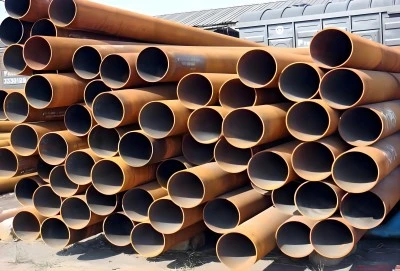
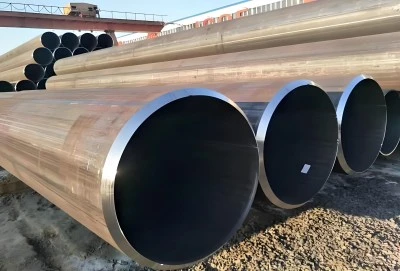
Overview of API 5L Steel Pipe Grades
What the API 5L Standard Covers
A standard called API 5L was made by the American Petroleum Institute. It tells companies how to make, test, and inspect line pipe that moves oil, natural gas, and water. The rule applies to pipes with outside diameters ranging from 1/8" to 80" and wall thicknesses ranging from SCH10 to SCH160. It also includes pipes that are either joined together (ERW, LSAW, and SSAW types) or not joined at all (SMLS).
PSL1 vs. PSL2: Two Quality Tiers
In the standard, there are two different levels of product specification items. PSL1 meets the basic mechanical and chemical needs of pipes that get mild use. According to PSL2, the amount of sulfur and phosphorus that can be present must be less than or equal to 0.015% S and 0.025% P. It also needs to be tested for Charpy V-Notch impact toughness and must be examined more thoroughly without damaging it. As a general rule, PSL2 is enough for jobs that have high pressure, bad service, or low temperatures.
Grade Progression at a Glance
It gets better from B to X42, X46, X52, X56, X60, X65, X70, and X80. It says that the API 5L steel pipe is high-strength by the letter "X" before the number. The number itself tells you the minimum yield strength in ksi. When the grade is higher, the walls can be thinner and still hold the same amount of pressure. This means that the material weighs less and costs less to ship.
Detailed Comparison of API 5L Grade B, X42, X52, X60, and X70
Chemical Composition and Weldability
Carbon equivalent (CE) controls how well a metal can be welded in the field. It is easier to make Grade B because it has more carbon in it, but it is more likely to harden in a heat-affected zone (HAZ). Micro-alloying elements such as niobium (Nb), vanadium (V), and titanium (Ti) are added to higher grades to make them stronger while keeping the CE level low. In this case, X70 PSL2 pipe generally has a yield strength above 485 MPa and a CE below 0.43. This means that the weld stays good even if it's in a faraway field.
The five main grades of API 5L steel pipe that engineers look at most often are shown next to each other:
- Grade B (245 MPa min. yield): Carbon-manganese steel with minimal alloying. Used for low-pressure distribution lines, water injection systems, and structural applications. The most cost-accessible grade and widely interchangeable with ASTM A53 Gr. B for moderate-service scenarios.
- X42 (290 MPa min. yield): A step above Grade B, X42 suits gathering lines and short-distance transmission where pressure loads are moderate. Its lower strength ceiling means heavier wall thicknesses are needed compared to higher grades, increasing material cost for long-haul lines.
- X52 (360 MPa min. yield): One of the most commonly specified grades in onshore transmission projects across the Middle East and Southeast Asia. X52 balances cost and performance — it supports operating pressures typical of regional trunk lines without demanding the tight manufacturing controls of X65 or X70.
- X60 (415 MPa min. yield): Preferred for high-pressure cross-country transmission and offshore tie-in spools. X60 PSL2 with NACE MR0175 compliance is the grade of choice for sour-service applications where hydrogen sulfide (H2S) is present in transported gas streams.
- X70 (485 MPa min. yield): The workhorse of long-distance high-volume transmission. Its high strength-to-weight ratio makes it the standard for large-diameter trunk lines (typically 24" to 60") in demanding environments. LSAW manufacturing is typical for heavy-wall X70 in offshore and arctic service.
Manufacturing Methods and Quality Standards
When very high pressure is needed and the pipe is small (usually less than 16"), seamless pipe works best. LSAW pipe is the best choice for transmission lines wider than 20 inches because it can handle thick walls and 100% weld seam checking with ultrasonic (UT) and radiographic (RT) tests. All grades at PSL2 must have full hydrostatic testing and EN 10204 3.1 or 3.2 Material Test Certificates (MTC) in order to pass third-party audits by SGS or Bureau Veritas.
How to Choose the Right API 5L Grade for Your Project?
Match Grade to Operating Pressure and Diameter
You should start with the design pressure from the technical standard of your owner. Use the Barlow method (P = 2St/D) to find the thinnest wall that can be built at each grade. If the grades are high, you can meet the pressure needs with smaller walls, but only if you know how to weld and build things on the land.
Factor in Environmental and Fluid Service Conditions
These pipes, which are made to API 5L Annex H or Annex J, need to be hard enough to meet the standards set by NACE MR0175/ISO 15156 for bad service conditions with H2S. For service needs in the Arctic or below zero, you need PSL2 with Drop Weight Tear Testing (DWTT) results that show it can bend at the lowest intended temperature. A lot of the time, third-party inspections fail because the grade is picked without these service addendums being looked over.
Verify Supplier Certification Validity
Every three years, you need to renew your API license. Make sure that the manufacturer's API 5L license covers the grade, width range, and PSL level that your project needs before you send out an RFQ. Find out right away what the license number is and when it expires. If you don't have the right license or it's out of date, you might miss project deadlines and have to pay money to get it again.
Common Challenges and Solutions When Working with API 5L Grades
Misapplication of Grade Capabilities
One problem that often comes up in EPC work is giving too many or too few details about the grade. Some project teams use X70 for all line pipes, no matter what the section pressure is. This wastes money and time. Other people use Grade B in slightly sour places without meeting the NACE hardness standard. This can cause sulfide stress cracking (SSC) breakdowns in the field. At the beginning of the engineering process, a grade-by-segment pressure study stops both of these mistakes.
Inspection and Third-Party Testing Gaps
For API 5L steel pipe PSL2, the weld seam and pipe body need to be fully UT. A full-length hydrostatic test is also needed, as well as chemical confirmation of the heat analysis and product analysis. The Inspection and Test Plan (ITP) should include a list of places where witnesses can be found, and EPC companies should be expected to provide at least EN 10204 3.1 paperwork for MTC. You should talk to the mill about an owner-witnessed check (3.2 MTC) when you place the order, not after production starts.
Keeping Pace with Evolving Export and Trade Standards
When it comes to selling papers, keeping track of goods, and anti-dumping, each country has its own rules. In order to clear customs, get a third-party inspection before shipping, and prove the goods' country of origin, suppliers who have shipped to the Middle East, Southeast Asia, and South America before know what paperwork is needed. All of these steps can slow down the project plan if they are not done correctly.
Why Longma Group Is a Dependable API 5L Steel Pipe Manufacturer
It has been making ERW and LSAW steel pipes in a 230,000 m² factory in Hebei, China, since 2003. They make more than a million tons of steel every year. The company has a valid API 5L license that covers grades PSL1 and PSL2 from B to X80. There are also ISO 9001, ISO 14001, and ISO 45001 marks on it.
It has wall thicknesses from SCH10 to SCH160 and sizes from 1/8" to 80". It also works with EN 10204 3.1 and 3.2 MTC paperwork. You can track the raw materials from the heat to the polished pipe. They come from Bao Steel, HBIS, Shagang, and Shougang. FBE, 3LPE, and 3PP coatings can help keep things from rusting. People who need to buy something quickly can get it from Longma Group the fastest, with delivery times that start at 7 days for some grades and sizes. The business has products that are sold in over 90 countries, and projects are still going on in South America, Southeast Asia, and the Middle East.
Conclusion
To pick the correct API 5L steel pipe grade, it's not just a matter of following the rules; it's also a business and technical choice that impacts the project's safety, timeline, and bottom line. With low pressure, Grade B is good for utility service. X42 and X52 are good for coastal gathering and regional transmission needs. And X60 and X70 are made for high pressure, long distance, and sour service. Before you send out an RFQ, make sure that the grade you pick meets the owner's standards for working pressure, service environment, PSL level, and inspection.
FAQ
What is the minimum yield strength difference between Grade B and X70?
At least 245 MPa (35,500 psi) is the yield strength of Grade B. Up to 485 MPa (70,300 psi) is the yield strength of X70. With a gap of 240 MPa, X70 pipe can hold a lot more pressure inside while keeping its wall thickness the same. That means it can be used for large, high-pressure trunk lines.
Does X52 PSL2 meet NACE MR0175 for sour service?
For a pipe to be ready for sour service, it's not enough just to have PSL2. The process of making it must follow API 5L Annex H or J. NACE MR0175/ISO 15156 must be used for hardness tests, and the sulfur level must be less than 0.003%. In your buy order, make sure that these needs are clear.
What is the difference between seamless and LSAW for X60 and above?
When the diameter is less than 16 inches and the pressure is very high, seamless pipe is usually better. LSAW is usually used to make big, thick-walled X60 and X70 pipes because it lets you keep the sizes the same and check every seam with UT and RT, which are both required by PSL2.
How long is an API 5L manufacturer license valid?
Every three years, API rights need to be updated. Always check a supplier's license number, end date, and grade range to make sure they meet the needs of your project before picking them.
Request a Quote from Longma Group — API 5L Steel Pipe Supplier for EPC Projects
The Longma Group sells API 5L steel pipe in grades B through X80, as well as PSL1 and PSL2. The items they sell are approved and come with all the necessary MTC paperwork. Our expert team is ready to help with your RFQ, from going over the specs to shipping the goods. Whether your project needs standard-sized pipes shipped quickly in 7 days or heavy-wall pipes that have been reviewed by a third party, we can do it all. Email us at info@longma-group.com or visit longma-group.com right away to get a price.