
Choosing the right line pipe grade can determine whether a pipeline project meets its schedule, budget, and safety benchmarks. ISO 3183 L485 pipe — the metric equivalent of API 5L X70 — is the dominant material for high-pressure, long-distance gas transmission and offshore oil delivery. With a minimum yield strength of 485 MPa and a tensile range of 570–760 MPa, it delivers high mechanical performance at competitive wall thickness, directly reducing steel volume and fabrication cost. This guide walks EPC procurement teams through specifications, selection criteria, supplier evaluation, and real-world applications so you can source with confidence.
|
|
|
Understanding ISO 3183 L485 Pipe – Specifications and Key Properties
What L485 Actually Means
According to ISO 3183, the "L" on the pipe means that it is a line pipe for moving oil and natural gas. As of 485 MPa, its minimum yield strength, the "485" makes it stronger than L450 but not as strong as L555. Tensile strength is between 570 and 760 MPa, and elongation is at least 20.5%. These numbers are not made up; they show the range of values that the pipe can withstand both static pressure loads and dynamic stress cycles over many years of use.
Chemical Composition and Microstructure
L485 has a high manganese level and a hybrid Nb-V microalloyed chemistry. The mill makes an acicular ferrite microstructure by controlling the thermomechanical rolling and speeding up the cooling process. This particular grain morphology is what gives L485 its high strength and good low-temperature hardness. These are qualities that are harder to get by normalizing the steel in the usual way. The carbon equivalent (CE) is carefully controlled to keep the weldability in the field within a good range.
Manufacturing Routes: LSAW vs. ERW
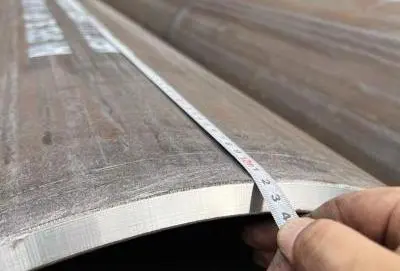
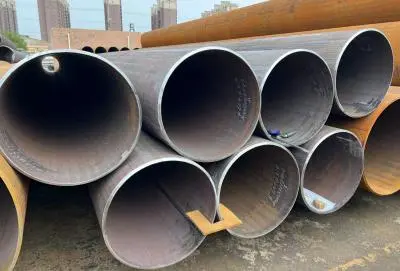
The L485 market is served by two main ways of making the product. Longitudinal Submerged Arc Welding (LSAW) is usually used for large-diameter, thick-wall jobs like underwater pipes and high-pressure trunk lines. It can handle diameters up to 1,524 mm and wall thicknesses over 40 mm. Electric Resistance Welding (ERW) is used for smaller diameters in gathering systems because it has tighter tolerances for size and higher production speed. The process choice has a direct effect on the mechanical properties of the weld zone and the NDT techniques that must be used for quality control.
Key Decision Factors When Choosing ISO 3183 L485 Pipes for Your Pipeline Project
PSL1 vs. PSL2 — The Certification Tier Matters
In both ISO 3183 L485 pipe and API 5L, production is split into two groups: PSL1 and PSL2. PSL1 includes basic standards for chemical and tensile strength. Charpy V-notch (CVN) impact testing is now required by PSL2. Tighter chemistry caps and fracture mechanics standards have also been added. At the very least, PSL2 is required for any project that moves fluid that contains H₂S. The pipe must be ordered as sour service (L485MS), and it must be tested for HIC according to NACE TM0284 and SSC according to NACE TM0177. Ordering the wrong tier leads to non-conformance during a third-party audit, which ends the project.
Low-Temperature Performance and DWTT Requirements
The acicular ferrite matrix in L485 gives it enough Charpy impact toughness at -40 °C, which is useful for cross-country lines in cold areas of Central Asia or high-altitude corridors in South America. The results of the Drop Weight Tear Test (DWTT) show that the pipe wall is strong enough to stop ductile cracks at their full thickness. EPC engineers shouldn't let the supplier decide on the test temperature and minimum absorbed energy; they should write them down in the purchase specification. A lot of the time, this information is missed in the first drafts of RFQs.
Comparing L485 with Neighboring Grades
L415 (X60) has a lower yield floor and needs thicker walls to have the same design pressure, which makes the steel tonnage higher. L555 (X80) calls for stricter process controls during both rolling in a mill and welding in the field. This makes it more expensive to qualify tools and procedures. L485 is the middle ground between L415 and L555 in terms of practicality. It is strong enough to allow thinner walls than L415 but not as easy to weld in the field as L555. L485 is the most cost-effective grade choice for most high-pressure gathering and cross-border gas transmission projects.
Procurement Considerations for ISO 3183 L485 Pipes
It takes more than just negotiating prices to get L485 pipe for a big EPC project. The choices made during seller approval have a direct effect on the number of accepted welds, the results of audits, and the time it takes to finish the project.
Here are the four things that experienced EPC buyers always do before they buy:
- Valid API 5L certificate coverage: Confirm the certificate expiry date extends beyond your project's final inspection milestone. An expired certificate during a third-party audit creates immediate non-conformance, regardless of the pipe's physical quality.
- EN 10204 3.1 or 3.2 MTC: Material Test Certificates must reflect actual heat and lot traceability. A 3.2 certificate requires an independent inspection body countersignature, which is mandatory on many owner specifications in the Middle East and offshore markets.
- 100% NDT — full-body UT and weld seam RT: Insist on full-body ultrasonic testing for laminar defects and radiographic or automated ultrasonic testing on the weld seam. SGS or Bureau Veritas (BV) third-party inspection reports provide the audit trail your owner representative will request.
- Delivery lead time and stock position: For large-diameter thick-wall LSAW ISO 3183 L485 pipe, standard mill lead time runs 60–90 days. Suppliers maintaining partial stock of common sizes can compress this to 7–15 days, which matters when a construction window is fixed.
When these checkpoints are used consistently during the technical evaluation phase, they lower the risk of supply problems in the middle of a project and the cost of welding repairs.
Case Studies and Real-World Applications of ISO 3183 L485 Pipes
Cross-Country Gas Transmission
From 24" to 56", L485 LSAW pipe has been used a lot in Central Asia and the Middle East for long-distance natural gas trunk lines. The grade's high strength-to-weight ratio lets designers make the walls thinner than with L415 at the same maximum allowable operating pressure (MAOP). This reduces the amount of steel used by 8–12% on similar pipeline segments. This directly means less freight cost per kilometer of ditch, which is important for projects longer than 500 km.
Shallow Offshore and Subsea Gathering
Deep offshore oil and gas delivery lines use anti-HIC and anti-SSCC versions of L485 that have been treated in a certain way. When used in this service, thick-wall LSAW pipes show strong resistance to both internal pressure and outward collapse under hydrostatic stress. Southeast Asian and South American projects have asked for L485 in the "M" (thermo-mechanically rolled) state to meet standards for sub-zero toughness while keeping total installation costs low.
High-Pressure Oilfield Gathering and LNG Export
A lot of the time, high-pressure gathering systems that connect wellheads to processing plants work at pressures that make it impossible to build walls that are thick enough for L415 to work. For safety reasons, switching to L485 gets wall thickness back down to a reasonable level. This grade was chosen for a number of LNG export pipeline projects because it has consistent weld quality and doesn't break easily at a wide range of temperatures.
Conclusion
Choosing the right type of line pipe is both an engineering and business choice that will affect the whole life of the project. L485 always performs well under high pressure, is tough at low temperatures, and can be welded in the field within the limits of the process. This is true whether it is defined under ISO 3183 L485 pipe or its API 5L X70 equivalent. Check for PSL2 certification, make sure the paperwork meets MTC standards, demand full NDT coverage, and compare the validity of the API certificate to the schedule for your project. When these steps are taken during the supplier qualification process, they stop specification deviations that lead to expensive rework or audit failures later on.
FAQ
1. Is ISO 3183 L485 the same as API 5L X70?
Yes. Technically, the two grades are the same. The international metric standard is ISO 3183, and the American standard is API 5L X70. Both have a minimum yield strength of 485 MPa (70,000 psi), a tensile range, and chemical needs that are very similar.
2. When must I specify sour service for L485 pipe?
Any pipeline that moves media with a partial H₂S pressure higher than the limits set by ISO 15156 and NACE MR0175 needs to meet sour service specifications. The pipe needs to be ordered as L485MS, and the MTC needs to show the results of the HIC and SSC tests.
3. What does the "M" suffix mean in L485M?
"M" stands for "thermomechanically rolled condition," which is a controlled rolling and accelerated cooling process that achieves the desired strength and toughness without the need for a heat treatment after rolling. For cold-region and ocean uses, it is often mentioned.
4. What NDT is standard for L485 LSAW pipe?
All laminates must go through full-body ultrasonic testing (UT), and the weld joint must go through radiographic or automatic ultrasonic testing (AUT). It is also necessary to do hydrostatic tests at a pressure of 90% of the minimum yield strength that was set.
5. What wall thickness range is available for large-diameter L485 LSAW pipe?
LSAW manufacturing can handle wall thicknesses ranging from about 6 mm to 50+ mm, based on the diameter. This includes normal schedule pipes as well as heavy-wall subsea uses.
Request a Quote from Longma Group — Your Trusted ISO 3183 L485 Pipe Supplier
Since 2003, Longma Group has been making API 5L and ISO 3183 line pipe for projects in more than 90 countries. Every year, we make more than a million tons, and every pipe we ship has valid API 5L PSL1/PSL2 certification, 100% UT/RT inspection records, and EN 10204 3.1/3.2 MTC certification. As a direct manufacturer of ISO 3183 L485 pipes, we don't have to pay markups to middlemen and allow plant checks by owners who are present. Email our expert team at info@longma-group.com to get prices and delivery times for your next job.








