
If you're sourcing pipe for a high-pressure gas transmission or offshore project, choosing the right supplier for ISO 3183 L485 pipe is one of the most consequential decisions you'll make. This grade — equivalent to API 5L X70 — carries a minimum yield strength of 485 MPa and a tensile strength range of 570–760 MPa, making it the go-to material for cross-border trunk lines and subsea systems. Before you sign a purchase order, these five questions will help you avoid costly mistakes and find a supplier you can trust across multiple project cycles.
|
|
|
What Are the Key Specifications of ISO 3183 L485 Pipes?
Mechanical Properties and Chemical Composition
L485 pipe is made from a combination of Nb-V microalloyed steel that has a lot of manganese in it. A controlled thermomechanical rolling and faster cooling process is used to create an acicular ferrite microstructure that is very strong and doesn't let cracks spread. The minimum elongation is ≥20.5%, which shows that the pipe can still bend easily when it's under stress. This is an important quality for buried and offshore installations that may be affected by ground movement or wave loading.
Manufacturing Methods and Their Trade-offs
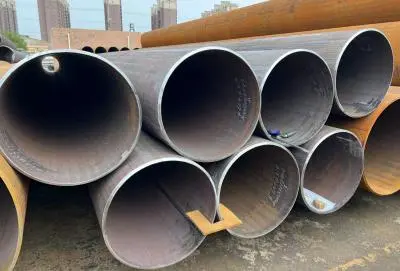
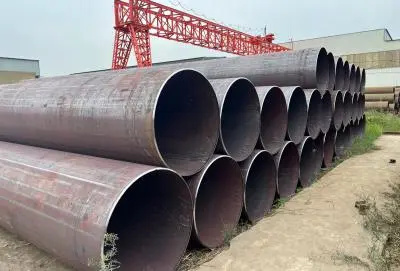
Longitudinal Submerged Arc Welded (LSAW) pipe is the best way to make large-diameter, thick-walled systems like underwater lines and high-pressure gathering systems. The two-sided welding process makes LSAW pipes very resistant to pressure inside and very good at preventing collapse outside. Smaller diameters and standard wall thicknesses work well with ERW pipe. The temperature range for rolling L485 is small, so only mills with high-tech controlled-rolling and accelerated-cooling tools can reliably meet the grade's property needs.
Typical Applications
L485 connects three main types of equipment. Natural gas transmission trunks that run across the country depend on its high strength-to-weight ratio, which lowers wall thickness and, by extension, material cost, while keeping the same design pressure as lower grades like L450. Anti-HIC and anti-SSCC versions that have been treated in a special way help with shallow- and medium-depth subsea pipes. The list ends with high-pressure oilfield gathering systems and LNG export pipelines. In cold working areas, Charpy impact toughness at -40 °C keeps the pipes from breaking easily.
How Does ISO 3183 L485 Compare to Other Pipe Grades?
L485 vs. L450 and L415
When you go from L450 to L485, the minimum yield strength goes up by 35 MPa. In real engineering terms, this means that the specified wall thickness can be slightly lowered while keeping the same design operating pressure. This lowers the total amount of steel used and the time it takes to weld on long-term projects. For EPC contractors with small profit margins, that difference can make the difference between a project being just barely profitable and being very profitable.
L485 vs. API 5L X70
In a scientific sense, ISO 3183 L485 pipe and API 5L X70 are the same. They have almost the same limits on chemical makeup and mechanical properties. If the contract standard is a project specification written to API 5L X70 PSL2, then a supplier certified under ISO 3183 for L485 PSL2 can meet that requirement, as long as the certificate clearly lists the correct edition year and product specification level.
When Not to Use L485
There are times when L485 is not the best deal. For moderate-pressure lines where L360 or L415 is enough, adding L485 adds cost without improving engineering. The grade's limited heat input range during field welding also requires Procedure Qualification Records (PQR) from certified welding experts, which takes time and costs more on distant sites where qualified people are hard to find.
Where and How to Procure ISO 3183 L485 Pipes?
Evaluating Supplier Certifications and Capacity
A reliable ISO 3183 L485 pipe supplier must have a valid API 5L license, not one that has expired or is still being processed. Check the license number on the API website and make sure that the expiration date fits within the time frame for delivering the project. Find out how much the mill currently makes each year and see if large-diameter, thick-wall LSAW pipe is in their normal production range, not just what they could theoretically make.
Lead Times, MOQ, and Customization
Lead times from Chinese mills for large-diameter LSAW L485 pipe are usually between four and eight weeks, but this depends on how many plates are available and the size of the order. Some sellers give priority scheduling to project batches that need to be done quickly. For example, Longma Group can help with faster shipping for orders that meet certain criteria. Make sure you know the minimum order quantity ahead of time, as some mills set tonnage floors that might not work with a specific project. Anti-corrosion coatings like 3LPE, FBE, and 2PP can be applied at the plant, which cuts down on the work that needs to be done on-site.
Sourcing Region Considerations
China is still the main place where L485 LSAW pipe is made by volume, with raw materials coming from big mills like Baosteel, HBIS, Shagang, and Shougang. As part of protocols for a traceable supply chain, these mills send plate to certified pipe manufacturers. People in the Middle East and North Africa can get goods from European makers with faster lead times, but the prices per unit are usually higher. Setting up a relationship with a single certified Chinese manufacturer that holds consistent API 5L PSL2 qualification can make the vendor approval process a lot easier for EPC procurement directors who are in charge of multiple projects in different regions.
What Technical Support and Quality Assurance Should Suppliers Provide?
Mandatory Testing Protocols
There is a lot more to quality control for L485 pipe than just looking at it. Before you place an order, you should make sure you meet these basic testing requirements:
- Full-body Ultrasonic Testing (UT): Detects laminations in the pipe body and checks weld seam integrity across the entire pipe length.
- Radiographic Testing (RT): Provides weld quality verification for LSAW seams, typically required by owners on PSL2 orders.
- Hydrostatic Testing: Performed at pressures up to 90% of specified minimum yield strength per ISO 3183 L485 pipe requirements.
- Charpy V-Notch (CVN) Impact Testing: Confirms toughness at specified sub-zero temperatures, mandatory under PSL2 and for cold-climate projects.
- Drop Weight Tear Test (DWTT): Evaluates ductile-to-brittle transition; particularly relevant for large-diameter trunk line pipe.
- HIC and SSC Testing: For sour service orders, corrosion tests per NACE TM0284 and NACE TM0177 verify resistance to hydrogen-induced cracking.
These tests are the proof that your QA/QC manager and the owner's third-party inspector will look at when they come to the mill to witness. If you miss even one item, it can cause a non-conformance report, which can slow down shipping and affect your project milestone.
Documentation and MTC Requirements
Make sure you get EN 10204 3.1 or 3.2 mill test certificates. While a 3.1 MTC is signed by the manufacturer's own inspection authority, a 3.2 MTC is co-signed by a third-party inspector from a company like SGS or Bureau Veritas. Before you start a project in the Middle East or Southeast Asia, where owners often send resident inspectors to the mill, make sure that the seller has a clear way for third parties to get in touch with them and help with hold points and witness inspections.
What Are the Risks and Common Pitfalls When Buying ISO 3183 L485 Pipes?
Red Flags in Supplier Evaluation
With project costs ranging from $5 million to $50 million per year, procurement pros can't afford to learn from bad supplier choices in the middle of a project. Keep an eye out for these signs:
- API 5L certificates that have expired or cover only PSL1 when your specification requires PSL2
- Mill test certificates with inconsistent heat numbers or missing chemical analysis columns
- Price quotations that fall more than 15% below market for equivalent specifications — this often signals substitution of lower-grade plate or thinner wall
- Suppliers who cannot provide a factory audit schedule or delay owner inspection arrangements without a clear technical reason
Risk Mitigation Through Contract Structure
A well-written buy order is the most important thing you can use to control risk. Name the standard version (for example, ISO 3183:2019), the PSL level, the delivery state (for example, "M" for thermomechanically rolled), the inspection hold points, and the MTC format. Set acceptance criteria for each test and make sure the supplier keeps pipe samples for a certain amount of time after shipping. These details in the contract give you a way out if problems arise in the field after installation, and they show the seller that you are conducting a professional buying process.
Conclusion
Finding the right ISO 3183 L485 pipe supplier comes down to five things that can be checked: they must have confirmed API 5L PSL2 certification, be able to produce large-diameter LSAW pipes, offer full NDT and corrosion tests, have full EN 10204 3.1/3.2 documentation, and have a history of supporting third-party mill inspections. If you answer each question before sending out your RFQ, you will greatly lower the technical and time risks of your pipeline project.
FAQ
1. Is ISO 3183 L485 the same as API 5L X70?
Yes. The two designations are technically equivalent. ISO 3183 uses the metric "L485" designation, while API 5L uses "X70." Chemical composition limits and mechanical property requirements are nearly identical across both standards.
2. What does the "M" suffix mean in L485M?
"M" stands for thermomechanically rolled. The pipe is processed through controlled deformation and temperature to achieve the required strength and toughness without a separate heat treatment step after rolling.
3. Can L485 pipe be used in sour gas service?
Only when specifically ordered as a sour service product — typically designated L485MS. This requires additional testing per ISO 15156 / NACE MR0175, including HIC and SSC resistance verification.
4. What welding precautions apply to L485?
Because of its elevated carbon equivalent, low-hydrogen welding consumables are required. Preheating may be necessary for thicker wall sections to prevent cold cracking in the heat-affected zone. A qualified welding procedure specification (WPS) and certified welders are mandatory.
5. How do I verify an API 5L certificate is genuine?
Visit the API's official monogram licensee database at api.org and search by the supplier's company name or license number. Confirm the license status is active and covers the relevant product category and edition.
Get Your L485 Line Pipe Quote from Longma Group
Since 2003, Longma Group has been making LSAW and ERW steel pipe. Each year, they make more than a million tons of product, which they send to more than 90 countries. We are a licensed ISO 3183 L485 pipe maker with certifications in API 5L PSL1 and PSL2 and ISO 9001 quality management. We also offer EN 10204 3.1/3.2 MTCs with full SGS/BV third-party testing support. Baosteel, HBIS, and Shagang are where the raw resources come from. To get a quote for your specific project, email our technical team at info@longma-group.com.








