
ISO 3183 L485 pipe is one of the most trusted high-strength line pipe grades in modern energy infrastructure. With a minimum yield strength of 485 MPa and a tensile strength range of 570–760 MPa, it meets the demanding mechanical requirements of high-pressure gas transmission, offshore delivery, and sour service environments. Its acicular ferrite microstructure—formed through controlled thermo-mechanical rolling using Nb-V composite microalloying—gives it both fracture resistance and excellent low-temperature toughness. For EPC procurement teams working under tight project schedules and strict owner specifications, this grade consistently satisfies API 5L PSL2 requirements and third-party audit standards.
|
|
|
Understanding ISO 3183 L485 Pipe: Specifications and Standards
Core Mechanical Properties
There is a minimum yield strength of 485 MPa, a minimum tensile strength of 570 to 760 MPa, and a minimum elongation of ≥20.5% in the L485 grade. These numbers aren't made up; they're based on how loaded cross-country trunk lines are when they're working at pressures above 10 MPa. Higher yield strength than L450 directly lets smaller wall sections be used with the same design pressure. This lowers the total amount of steel used per project kilometer and lowers the cost of materials.
Chemical Composition and Microstructure
L485 has a higher manganese level and uses a Nb-V hybrid microalloy. Controlled rolling and fast cooling make the steel form an acicular ferrite matrix, a feature that stops cracks from spreading. Charpy V-notch impact toughness stays high at -40 °C, so the pipe can be used in cold plateau areas and sites close to the Arctic. The crack-stopping level for the Drop Weight Tear Test (DWTT) is significantly higher than that of lower-grade options.
Manufacturing Precision and Dimensional Tolerances
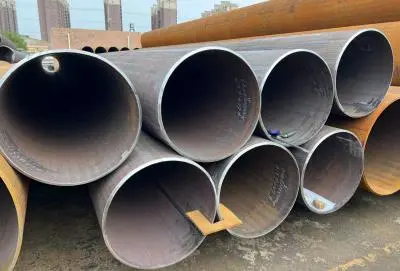
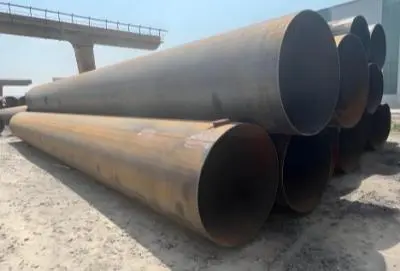
Longitudinal Submerged Arc Welded (LSAW) production is the standard for heavy-duty uses with large diameters. It is very important for field fit-up and automatic welding that the wall thickness, outer diameter, and straightness are all very close to the limits. Because L485 has a small temperature range during hot rolling and fast cooling, it needs high-tech mill tools to be made reliably. Not all manufacturers can do this. Before sending an RFQ, buyers should make sure that the mill specs of the seller cover this grade.
Advantages of ISO 3183 L485 Pipe for Oil and Gas Applications
Real technical problems can be solved with the L485 grade, which isn't possible with lower-strength classes. Here are the main technical benefits that make it the most popular choice for sending gas over long distances right now.
- Cost reduction through wall thickness optimization. Because yield strength is higher than L360 or L450, engineers can specify thinner walls under the same design pressure. On a 100 km pipeline, this can reduce steel consumption by 8–12%, translating directly into procurement savings.
- Low-temperature fracture resistance. The acicular ferrite matrix maintains ductile behavior at −40 °C. This is not a theoretical claim—CVN and DWTT testing under ISO 3183 L485 pipe requirements validates it per batch. For projects in Central Asia or high-altitude South American routes, this property is non-negotiable.
- Sour service compatibility. When ordered as L485MS (sour service variant), the pipe passes HIC testing per NACE TM0284 and SSC testing per NACE TM0177/ISO 15156. Anti-HIC and anti-SSCC treatments make it suitable for H₂S-containing media in oilfield gathering systems and offshore tie-in lines.
- Offshore pressure resistance. Thick-wall LSAW pipes in L485 grade show strong resistance to both internal pressure and external hydrostatic collapse, making them practical for shallow and medium-depth subsea pipelines where both load types act simultaneously.
These benefits directly lead to lower lifecycle costs, fewer failures in the field, and easier third-party audits, which are all things that EPC procurement teams always aim for.
ISO 3183 L485 vs Alternatives: Making the Right Pipeline Steel Grade Choice
L485 vs API 5L X70
Technically, they are the same. API 5L X70 and ISO 3183 L485 have almost the same chemical and mechanical requirements. Difference in standards: ISO 3183 is the metric standard used around the world, while API 5L is the American standard. Most owner specs in South America, Southeast Asia, and the Middle East accept both. Ask your supplier for an MTC that lists both standards if you want a dual-certified supply.
L485 vs L360 and L450
L360 and L450 are good for low-pressure transmission lines or systems that collect water where the design pressures are moderate. If you use L360 instead of L485 on high-pressure trunk lines, the walls would have to be much thicker to meet hoop stress limits. This would make the material heavier and cost more to make. Standard calculations for pipeline design show that the economic crossover point usually leans toward L485 for pipelines with an operating pressure of 6 to 8 MPa.
L485 vs L555
L555, which is the same as X80, is stronger, but it makes field welding, controlling heat-affected zones, and qualifying the weld process more difficult. It is usually only used for very high-pressure or long-distance projects where the extra work needed to make it is worth it to reduce weight. When the pressure is between 10 and 12 MPa, L485 is still the best and most cost-effective choice for most cross-country gas projects.
Procurement and Supply Chain Considerations for ISO 3183 L485 Pipe
Certification and Documentation Requirements
Any ISO 3183 L485 pipe provider you can trust must have an up-to-date API 5L license that covers both PSL1 and PSL2 and an EN 10204 3.1 or 3.2 Material Test Certificate. For bad service requests, you must have proof that you follow NACE MR0175 and ISO 15156. Technical specs from the owner usually call for inspection results from a third party, like SGS or Bureau Veritas. Make sure that the API certificate expiration date fits within the inspection and delivery time for your project. This is a common oversight that leads to audit delays.
Supplier Evaluation and Lead Time
Most mills don't keep large-diameter thick-wall LSAW pipe in grade L485 on hand. Most of the time, it takes 45 to 90 days from the time an order is confirmed for sizes that aren't in stock. When it comes to urgent project phases, suppliers that offer verified 7-day fast delivery on in-stock sizes give you a lot of schedule flexibility. When evaluating suppliers, make sure you check the mill's real rolling ability for the wall thickness and diameter you need, not just their choice of products that they advertize.
Trade Compliance and Logistics
EPC workers who buy from Chinese makers should make sure that export paperwork like country-of-origin certificates, packing lists, and customs HS codes is ready ahead of time. To avoid delays at the port caused by traffic, the mill, the third-party inspector, and the freight forwarder need to be able to work together with clear schedules. It is much easier to get things to where they need to go if you choose a manufacturer with experience exporting to the Middle East, Southeast Asia, or South America.
Best Practices for Using ISO 3183 L485 Pipe in Oil and Gas Projects
Welding Procedure and Operator Qualification
In field welding, L485 only takes in a small amount of heat. It is necessary to use low-hydrogen products (E8010, E8018, or similar). The preheat temperature is usually between 50 and 100 °C for walls that are more than 20 mm thick and have a carbon equivalent of 0. All welding methods must meet the requirements of API 1104 or ISO 15614, and workers must have up-to-date credentials. If you skip preheating or use the wrong materials, there is a higher chance of cold cracking in the heat-affected zone.
Inspection and Non-Destructive Testing
The basic NDT standards are full-body ultrasonic testing (UT) to find laminations and radiography testing (RT) to make sure the weld seam is solid. ISO 3183 says that you have to do hydrostatic tests at 90% of the minimum yield strength. For PSL2 orders, each heat must be accompanied by CVN impact tests at the right temperature. Keep all MTCs and NDT reports in order so that the owner can look them over. It is a standard audit requirement to show that you can trace materials from raw materials to finished pipes.
Corrosion Protection and Storage
Before they are put in place, the outside of the pipes is usually coated with 3LPE, FBE, or 2PP systems, based on the type of dirt and the expected life of the pipes. Concrete weight coating or heat insulation may be used for underwater uses. Pipes should be stored on-site on padding supports that are off the ground, and the ends of the pipes should be closed to keep water out. Before going down into the hole, use a holiday detector to check the consistency of the coating.
Conclusion
It is used in oil and gas infrastructure because ISO 3183 L485 pipe has good mechanical performance, can handle sour service, and is cost-effective. Its tensile strength of 485 MPa, acicular ferrite microstructure, and PSL2-compliant testing regime all address the same risks that pipeline engineers and EPC procurement heads deal with every day. It gives project teams the technical base they need to confidently pass owner audits and meet contract milestones when it comes from a certified manufacturer with full documentation and NDT traceability.
FAQ
1. How does ISO 3183 L485 differ from API 5L X70?
They are technically equivalent grades. ISO 3183 L485 is the international standard designation, while API 5L X70 is the American designation. Both share nearly identical chemical composition and mechanical property requirements. Most owner specifications in international markets accept either standard.
2. Is L485 pipe suitable for sour gas service?
Only when specifically ordered as a sour service grade (e.g., L485MS). This requires additional HIC testing per NACE TM0284 and SSC testing per NACE TM0177, along with compliance with ISO 15156/NACE MR0175. Standard L485 pipe is not automatically qualified for H₂S environments.
3. What does the 'M' suffix mean in L485M?
'M' stands for thermo-mechanically rolled. This production condition uses controlled deformation and cooling temperatures to achieve high strength and low-temperature toughness without a separate heat treatment step.
4. What certifications should I require from a supplier?
At minimum: a current API 5L license covering PSL2, EN 10204 3.1 MTC, 100% UT/RT results, hydrostatic test records, and CVN impact test data. For sour service, add HIC and SSC test reports.
5. Can L485 pipe be used in cold climates?
Yes. PSL2 L485 pipe with mandatory CVN testing maintains ductile fracture behavior at −40 °C, meeting the requirements of projects in Central Asia, high-altitude South America, and similar environments.
Source Your ISO 3183 L485 Pipe Through Longma Group
Since 2003, Longma Group has been making certified LSAW and ERW steel pipe. Each year, they make more than a million tons of pipe and send it to more than 90 countries. API 5L PSL1 and PSL2 certification, EN 10204 3.1/3.2 MTCs, 100% UT/RT inspection, and third-party witness help from SGS or Bureau Veritas are some of the things that our ISO 3183 L485 pipe seller can do. You can email our technical team at info@longma-group.com to get a quote or a package of product documentation that is specifically made for your project.








